Sunday, June 28, 2009

New Nagorno-Karabakh War on the Horizon

On June 26, Azerbaijan's President Ilham Aliyev declared Azerbaijan's military was ready to "restore its territorial integrity" at any moment. Aliyev called the ongoing peace talks "fruitless" and that his left only the military option. He further argued that Azerbaijan has the "sovereign right" to retake Nagorno-Karabakh with force if Armenia doesn't show more flexibility in negotations.

While analysts claim his remarks are meant to rally nationalist support recent military exercises could be part of preparations for a military incursion. In particular the fact the war games were called the "Restoration of the Territorial Integrity of the Republic of Azerbaijan" suggests it may be in preparation for an actual military intervention. The key determining factor could be talks in Russia mid-July on a peace deal. The convergence of these events are somewhat opposed to his comments merely being rhetoric. Kosovo's independence and the recognition of Abkhazia and South Ossetia have also put additional pressure on Azerbaijan.

A conflict in Nagorno-Karabakh also has potential to spread into Georgia where recent protests by ethnic Armenians in Javakheti led to clashes with police. A speaker of the Georgian parliament suggested Russia could provoke a scenario like Nagorno-Karabakh in the region.

Russian military exercises ending in early July could be a sign of preparations for such conflict. The exercises called KavKaz 2009 would involve the Black Sea Fleet, North Caucasian forces, and critically the Caspian Flotilla. While involvement of the Black Sea and South Ossetian and Abkhaz forces indicate it most likely involve, but the Caspian Flotilla's involvement suggests the conflict entails more than a conflict with Georgia. It most likely means a conflict with Azerbaijan. This could mean Russia is preparing for a scenario where a new conflict erupts with Georgia probably following an Azeri invasion of Nagorno-Karabakh.

A U.S. military scenario in 2006 involving the deployment of U.S. military forces to prevent an invasion of Azerbaijan by a third country, most likely Russia, could be realized with Armenia being a member of the CSTO. Such a development would erase what little progress has been made in U.S.-Russian relations.

Coup lauched in Honduras

On the day of Manuel Zelaya's expected referendum the military surrounded the presidential palace and removed Zelaya. Zelaya was taken to an air base outside the capital with reports he is being sent into exile. The military briefly clashed with supporters of Zelaya outside the presidential palace.

Troops also had seized documents related to the planned referendum. Soldiers have been deployed across the capital of Honduras to prevent any unrest in response to the coup. What follows next will be key to any escalation. Venezuela and its allies have pledged to support Zelaya in any way possible and as such might make moves to intervene in Honduras.

Most immediate signs will likely come from Nicaragua though an invasion is unlikely at this stage.

Saturday, June 27, 2009

Next Battleground for resistance to U.S. in Honduras

June 28 in Honduras President Manuel Zelaya is planning to hold a consultative referendum on whether to place a measure calling for a Constituent Assembly to change the Constitution on the November ballot. Zelaya is doing this over the objections of his own party, the Supreme Court, and military. Opposition from the head of the military led to Zelaya moving to relieve him. At the same time the Congress has launched an investigation into his mental state which could find him unfit to rule. The result would be the president of Congress, Roberto Micheletti, taking the Presidency. Despite being from Zelaya's own part he has been one of the major critics of Zelaya's efforts.

However such efforts could rile his supporters who have already shown considerable resistance to the present system going so far as to go to an Air Force base where ballots were being held for destruction to retrieve them and distribute them to polling stations. Should Zelaya be removed through essentially a legal coup popular resistance could emerge to the action potentially resulting in conflicts with the military.

People have been warned not to vote in the referendum because they could be attacked by Zelaya supporters. The Micheletti claimed Zelaya's supporters might assassinate him. All of this heightens tension in preparation for the referendum and there exists a risk that military forces will block people from voting resulting with battles in the streets.

Potential consequences of these developments are considerable. Should Zelaya be found unfit to rule by Congress he is likely to ignore the ruling and use his supporters to shield him from forcible removal. If the security forces press through supporters violently to foricbly remove Zelaya it would likely result in mass unrest or even civil war. This could open up a much bigger can of worms for the region.

Under Zelaya Honduras has joined the Bolivarian Alliance for the People of Our America which includes the nations of Venezuela, Bolivia, Ecuador, Nicaragua, Cuba and several small caribbean nations. President Hugo Chavez of Venezuela has promised to support Zelaya together with his allies in any way they could. Of most immediate consequence would be Nicaragua which shares its northern border with Honduras. Nicaragua could be used as a passageway for weapons from Cuba or Venezuela to support a resistance to any military-imposed government. Should the situation escalate further all-out war is a distinc possibility.

That scenario could involve a very short conflict involving an invasion from Nicaragua by ALBA military forces especially Venezuelan forces. One major risk is that the U.S. intervenes in support of the Honduran government through direct military force or a blockade. In the event U.S. forces are deployed in Honduras and come into conflict with ALBA military forces further escalations become possible with Russia and/or Brazil moving to warn off the U.S. from intervention.

Developments in Honduras are further evidence of a growing trend involving conflict between American-backed forces and Russian-backed leftists in Latin America. September 2008's unrest in Bolivia and the Colombian strike which nearly sparked a war Ecuador and Venezuela in March of the same year indicate more events are likely to occur in the future.

Wednesday, May 20, 2009

Drums of war grow louder in East Africa

Moves towards peace between Chad and Sudan appear to have collapsed following a renewed offensive by Chadian rebels opposed to the government of Idriss Deby. While the attack was halted, Chad's government is concerned they will attempt another attack and is blaming Sudan for the Chadian rebel assault. The government of Chad has already launched several cross-border attacks into Sudan in an attempt to stop the rebel. Chad is now building troops on its border and says it intends to launch an offensive soon into Sudanese territory to prevent a renewed attack by the rebels.

Sudan is warning Chad that any Chadian troops which move into Sudanese territory will be "destroyed" by Sudanese forces. While the forces of Sudan's military are much stronger a conflict with Chad has the potential to bring in France and the EU in support which could escalate further with an outbreak of violence in South Sudan.

Nearby the Western-backed government in Somalia is at risk of collapse as Al-Shabab and other Islamist militants take large swathes of territory. Militants have launched a major attack on Mogadishu and have managed to secure most of the city. All that remains outside the control of Shabab is the center of the city containing government buildings and the port. These areas are secured not only by militias but the 4,000 African Union troops sent in as peacekeepers. Though fighting has died down in the capital the militants appear to be tightening the noose around the nascent government.

Shabab and its allies have seized two key towns north of the capital. Jowhar and Mahaday both lie along roads key to maintaing ties between governments forces in Mogadishu and areas controlled by allied militias in Central Somalia. With their significant presence in Mogadishu already established and the government choked off from potential support up north the Shabab and its allies can move to take the remaining parts of the capital and topple the government. To prevent this from happening East African nations are calling for the UN to enforce a sea and air blockade of insurgent-run cities and regions.

If efforts to prop up the transitional government fail and the country is taken over by Islamist militants potential for further violence remains. Aside from possible international intervention other potential civil conflicts could emerge. Puntland officials are warning the pirates based out of the Somali region could become the next warlords and build up their own armies. If Shabab is able to topple the government in Mogadishu and establish control of Southern Somalia, the Puntland region would be their likely next target where warlords could be potential allies of either side or third parties in the conflict.

After falling a second time to Islamists its possible no major challenges will emerge to their power and a Taliban-style government will impose order in the region. Such a government would also be likely to shelter foreign fighters like al-Qaeda allowing them to build their own strength.

Wednesday, March 11, 2009

Pakistan moving towards Civil War

In just a few short days members of Pakistan's opposition plan to start a march intended to go from Karachi to Islamabad. This march is meant to protest the current government's failure to reinstate the judge dismissed by Musharraf in 2007. The leader of the opposition, Nawaz Sharif, has been banned from contesting elections and is likely to fuel the protests. In addition Pakistan's precarious economic and security situation will be another source of protest. Some are expecting hundreds of thousands of protesters to participate. In Punjab the provincial government has banned all protests as well as brining in paramilitary forces with the government saying regular military forces could be called in to deal with protesters. At the same time reports are coming in of the head of the armed forces warning President Zardari to resolve the crisis before March 16th, the day the march concludes in Islamabad inciting fears of a military coup.

Such a crisis as hundreds of thousands of people confronting military troops in the streets could easily spiral out of control resulting in mass unrest. Another factor contributing to this potential for instability is the Taliban which continues to increase its power. Several rival Taliban groups have joined forces and pledged to defend each other from attacks. The numerous groups control a swath of territory across the Federally-Administered Tribal Areas and the Northwest Frontier Province. Their control has also been effectively expanded with the concession by the Pakistani government to allow sharia law in the Swat Valley after a military operation failed to defeat Taliban forces there.

Risk to the rest of Pakistan has gradually increased as well with an attack on a police checkpoint in Punjab province a possible sign of the conflict expanding into larger Pakistani provinces. Baitullah Mahsud, the leader of a Pakistani Taliban group, warned his group would expand actions to Punjab and Sindh province if the government continued conducting operations in the northwest. In Sindh there are reports the Taliban is capable of widening the conflict all the way to the coast. A police reports on the Taliban indicated a large presence in the city of Karachi with stockpiles of weapons warning the Taliban could take the city hostage at a moment's notice. Civil unrest resulting from the ongoing political crisis could serve as the perfect backdrop for the Taliban to make such a big move. Whether they could only cause a Mumbai-style attack or launch a full-on uprising in the city is uncertain though it would likely be somewhere in between given the larger numbers of Taliban forces in the city and the higher levels of support.

Karachi is not the only city of notable concern. Peshawar is the capital of the Northwest Frontier Province and has been a frequent source of concern for the Pakistani government with rising fears the Taliban are poised to seize the city. City residents have suffered harassment from Taliban and their sympathizers while trucks delivering supplies to U.S. forces in Afghanistan have come under increasinly intensive attacks. Police and paramilitary forces come under frequent attack in and around the city as well as high-level political officials. With the Taliban becoming more united in the northwest and receiving larger safe havens like the Swat Valley their ability to take the provincial capital increases every day. Were the Taliban to succeed in taking the city it is likely the entire province would soon follow and put the Taliban on the doorstep of Islamabad. Were this coordinated with aggressive actions in Punjab and a seizure of Karachi while the central government is distracted by large civil unrest from the political opposition a full-on civil war in Pakistan would become highly likely.

Saturday, January 24, 2009

Trouble in Nagorno-Karabakh

With tensions still brewing between Georgia and Russia following the August war last year signs of potential conflict between Azerbaijan and Armenia is growing. On January 17th an Azeri soldier was reportedly killed after an attack from Nagorno-Karabakh. Further violations by Armenia were reported on January 22nd with Armenian armed forces launching attacks on Azeri positions near Yusifjanly village of Aghdam, Gervend village and two other locations in Fizuli and Khojavend. Only two days later more attacks were reported to have been launched on Sarijaly village of Aghdam, Gorgan village, and a location in Fizuli.

This situation in Nagorno-Karabakh is the most complicated and volatile in the region. With Armenia having a collective defense agreement with Russia. On the other side are Turkey and Azerbaijan presently both allies of the United States. While Georgia's role in diverting Caspian gas from Russia was noted during the conflict between Russia and Georgia, Azerbaijan plays the even more crucial role of being a natural gas producer and major port for natural gas from Kazakhstan and Turkmenistan two nations the European Union has sought to tap as a way of reducing its dependence on Russia.

More troubling is that this conflict has been the apparent subject of a U.S. military exercise involving the deployment of U.S. troops into Azerbaijan. While no threat was specified it specifically referenced the Korean Way as a model with a conflict between two nations risking intervention by a third power with U.S. forces having to move in to prevent of possible fight those forces. The theoretical deployment involved troops stationed near Azeri held parts of Nagorno-Karabakh and the movement of troops around Baku to defend against external threats.

While the violations appear minor the risk is that if they continue Azerbaijan's government, eager to retake Nagorno-Karabakh, will initiate broader hostilities. If that occurs the situation will likely lead to Russian intervention of threat of intervention, especially if Azerbaijan has success against forces in Nagorno-Karabakh to the point of positioning for attack on Armenia itself. The relatively meager response by U.S. forces could encourage President Obama to send troops into Azerbaijan to ward off any Russian response. This would also include a condition on the part of Azerbaijan that the offensive not lead to any attack on Armenia. While such a response would have been more likely under a McCain administration Obama could view such an operation as a way of flexing his muscle and legitimizing himself in the international community. Indeed, it may very well be the crisis Joe Biden mentioned as testing Obama in his first months in office as it would likely be an unpopular move, though serving to demonstrate his strong hand on foreign affairs.

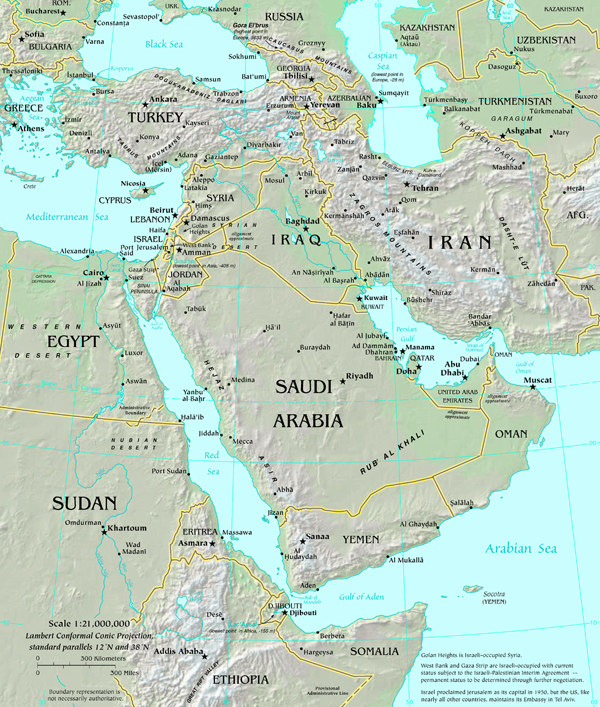
Near the brink in the Middle East

Israel's invasion of Gaza has managed to severely weaken Hamas, which appears to have not yet achieved Hezbollah-style capability, but the conflict has caused a shift in the geopolitical situation. The conflict had risked spreading to the rest of the Middle East after several rockets were fired from Southern Lebanon. Israel's decision not to launch a full-scale attack on Gaza city and depose Hamas likely prevented the conflict from erupting into a regional conflict. However, Israel remains intent on deposing Hamas through other means by having the reconstruction efforts led by Fatah in the hope it would get more support for the secular party in Gaza. Other regional powers are moving to back Fatah all in the hopes Hamas in its weakened state could fall, though a military takeover by Fatah seems unlikely.

However, Israel's decision also leads to the drawback that Hamas will now be able to improve its training and resupply. In this sense while Hamas did not show the capabilities of Hezbollah it may ultimately achieve the same aims. At the same time Hamas lacks the advantage Hezbollah enjoys in that a direct land route between it and Iran, the biggest likely source of assistance, can only travel through Israel.

The biggest impact of the conflict has been on the relations between Turkey and Israel. During the conflict Turkey's Prime Minister Recep Tayiip Erdogan accused Israel of committing "crimes against humanity" and said Allah would punish Israel. Erdogan even suggested Israel was putting itself on the path to self-destruction, the kind of rhetoric rivalled only by that of Iranian President Mahmoud Ahmadinejad. The Prime Minister was even refusing calls from Israeli Prime Minister Ehud Olmert during the conflict. Erdogan went so far as to call for Israel to be barred from the U.N. saying:
How is such a country, which totally ignores and does not implement resolutions of the U.N. Security Council, allowed to enter through the gates of the U.N.?
Strain in Turkish-Israeli relations is impacting political relations in other ways as the Turkish Parliament has ended the inter-parliamentary friendship group with the Israeli Knesset. Visits to Turkey by Israeli officials have also been canceled. Jewish leaders and Jewish groups in the U.S. including the Anti-Defamation League and B'nai B'rith International are also concerned at increasing acts of anti-Semitism in Turkey. Such actions including attacks and protests could pose problems for Israeli relations. The overall decline in relations is naturally spreading to the business atmosphere between the two countries. Turkish travel agencies are seeing a 70% decline in traffic by tourists, Muslim businesses in Turkey are disassociating themselves from their Jewish counterparts, and over a dozen groups have been formed by Israelis to "ban Turkey" in response to Erdogan's comments about kicking Israel out of the U.N.

With Turkey moving further from Israel and closer to Iran the chances of Turkey allowing the arming of Hezbollah through Iran and Syria increases. With Hamas effectively out of the picture it is that sphere which stands to bring the most likely chance of renewed conflict. Hezbollah is saying it is prepared for Israeli action against them and Israel is receiving intelligence indicating the group is planning an attack in retaliation for the assassination of Imad Mugniyeh. Of particular interest is the one-year anniversary of the killing on February 12th. This happens to coincide with the Israeli elections on February 10th making it a period with strong potential for renewed conflict. If Likud should win the elections as most polls indicate it will it makes it highly likely that any attack would receive a more devastating response or that Israel would launch an attack on Hezbollah without a serious provocation.

It would also increase the chance of an Israeli strike against Iran. In this sense another pivitol development is incoming as Iran is looking for more uranium. Iran currently is said to have enough enriched uranium for 35 nuclear bombs. If Iran manages to get a major shipment of uranium or merely continues its progress on nuclear enrichment a Likud government will be more tempted to use force against Iran. One way or the other a major regional war in the Middle East is inevitable, it is only a question of time.