Wednesday, May 20, 2009

Drums of war grow louder in East Africa

Moves towards peace between Chad and Sudan appear to have collapsed following a renewed offensive by Chadian rebels opposed to the government of Idriss Deby. While the attack was halted, Chad's government is concerned they will attempt another attack and is blaming Sudan for the Chadian rebel assault. The government of Chad has already launched several cross-border attacks into Sudan in an attempt to stop the rebel. Chad is now building troops on its border and says it intends to launch an offensive soon into Sudanese territory to prevent a renewed attack by the rebels.

Sudan is warning Chad that any Chadian troops which move into Sudanese territory will be "destroyed" by Sudanese forces. While the forces of Sudan's military are much stronger a conflict with Chad has the potential to bring in France and the EU in support which could escalate further with an outbreak of violence in South Sudan.

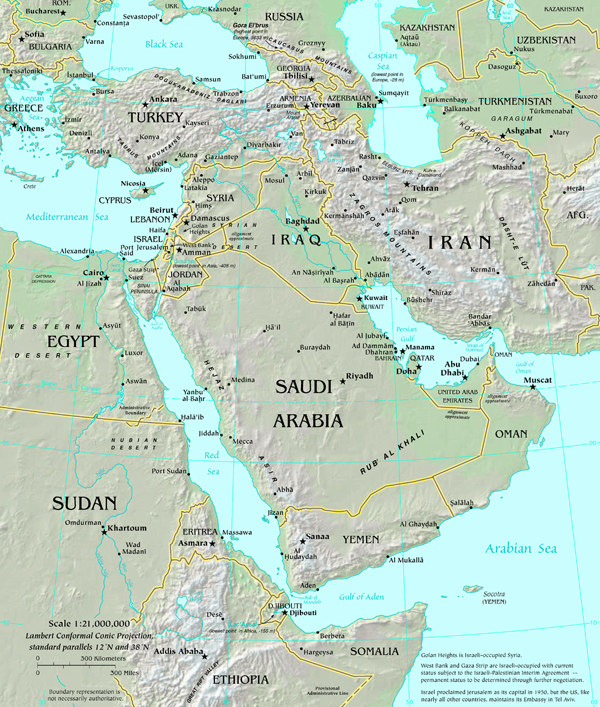
Nearby the Western-backed government in Somalia is at risk of collapse as Al-Shabab and other Islamist militants take large swathes of territory. Militants have launched a major attack on Mogadishu and have managed to secure most of the city. All that remains outside the control of Shabab is the center of the city containing government buildings and the port. These areas are secured not only by militias but the 4,000 African Union troops sent in as peacekeepers. Though fighting has died down in the capital the militants appear to be tightening the noose around the nascent government.

Shabab and its allies have seized two key towns north of the capital. Jowhar and Mahaday both lie along roads key to maintaing ties between governments forces in Mogadishu and areas controlled by allied militias in Central Somalia. With their significant presence in Mogadishu already established and the government choked off from potential support up north the Shabab and its allies can move to take the remaining parts of the capital and topple the government. To prevent this from happening East African nations are calling for the UN to enforce a sea and air blockade of insurgent-run cities and regions.

If efforts to prop up the transitional government fail and the country is taken over by Islamist militants potential for further violence remains. Aside from possible international intervention other potential civil conflicts could emerge. Puntland officials are warning the pirates based out of the Somali region could become the next warlords and build up their own armies. If Shabab is able to topple the government in Mogadishu and establish control of Southern Somalia, the Puntland region would be their likely next target where warlords could be potential allies of either side or third parties in the conflict.

After falling a second time to Islamists its possible no major challenges will emerge to their power and a Taliban-style government will impose order in the region. Such a government would also be likely to shelter foreign fighters like al-Qaeda allowing them to build their own strength.

Wednesday, March 11, 2009

Pakistan moving towards Civil War

In just a few short days members of Pakistan's opposition plan to start a march intended to go from Karachi to Islamabad. This march is meant to protest the current government's failure to reinstate the judge dismissed by Musharraf in 2007. The leader of the opposition, Nawaz Sharif, has been banned from contesting elections and is likely to fuel the protests. In addition Pakistan's precarious economic and security situation will be another source of protest. Some are expecting hundreds of thousands of protesters to participate. In Punjab the provincial government has banned all protests as well as brining in paramilitary forces with the government saying regular military forces could be called in to deal with protesters. At the same time reports are coming in of the head of the armed forces warning President Zardari to resolve the crisis before March 16th, the day the march concludes in Islamabad inciting fears of a military coup.

Such a crisis as hundreds of thousands of people confronting military troops in the streets could easily spiral out of control resulting in mass unrest. Another factor contributing to this potential for instability is the Taliban which continues to increase its power. Several rival Taliban groups have joined forces and pledged to defend each other from attacks. The numerous groups control a swath of territory across the Federally-Administered Tribal Areas and the Northwest Frontier Province. Their control has also been effectively expanded with the concession by the Pakistani government to allow sharia law in the Swat Valley after a military operation failed to defeat Taliban forces there.

Risk to the rest of Pakistan has gradually increased as well with an attack on a police checkpoint in Punjab province a possible sign of the conflict expanding into larger Pakistani provinces. Baitullah Mahsud, the leader of a Pakistani Taliban group, warned his group would expand actions to Punjab and Sindh province if the government continued conducting operations in the northwest. In Sindh there are reports the Taliban is capable of widening the conflict all the way to the coast. A police reports on the Taliban indicated a large presence in the city of Karachi with stockpiles of weapons warning the Taliban could take the city hostage at a moment's notice. Civil unrest resulting from the ongoing political crisis could serve as the perfect backdrop for the Taliban to make such a big move. Whether they could only cause a Mumbai-style attack or launch a full-on uprising in the city is uncertain though it would likely be somewhere in between given the larger numbers of Taliban forces in the city and the higher levels of support.

Karachi is not the only city of notable concern. Peshawar is the capital of the Northwest Frontier Province and has been a frequent source of concern for the Pakistani government with rising fears the Taliban are poised to seize the city. City residents have suffered harassment from Taliban and their sympathizers while trucks delivering supplies to U.S. forces in Afghanistan have come under increasinly intensive attacks. Police and paramilitary forces come under frequent attack in and around the city as well as high-level political officials. With the Taliban becoming more united in the northwest and receiving larger safe havens like the Swat Valley their ability to take the provincial capital increases every day. Were the Taliban to succeed in taking the city it is likely the entire province would soon follow and put the Taliban on the doorstep of Islamabad. Were this coordinated with aggressive actions in Punjab and a seizure of Karachi while the central government is distracted by large civil unrest from the political opposition a full-on civil war in Pakistan would become highly likely.

Saturday, January 24, 2009

Trouble in Nagorno-Karabakh

With tensions still brewing between Georgia and Russia following the August war last year signs of potential conflict between Azerbaijan and Armenia is growing. On January 17th an Azeri soldier was reportedly killed after an attack from Nagorno-Karabakh. Further violations by Armenia were reported on January 22nd with Armenian armed forces launching attacks on Azeri positions near Yusifjanly village of Aghdam, Gervend village and two other locations in Fizuli and Khojavend. Only two days later more attacks were reported to have been launched on Sarijaly village of Aghdam, Gorgan village, and a location in Fizuli.

This situation in Nagorno-Karabakh is the most complicated and volatile in the region. With Armenia having a collective defense agreement with Russia. On the other side are Turkey and Azerbaijan presently both allies of the United States. While Georgia's role in diverting Caspian gas from Russia was noted during the conflict between Russia and Georgia, Azerbaijan plays the even more crucial role of being a natural gas producer and major port for natural gas from Kazakhstan and Turkmenistan two nations the European Union has sought to tap as a way of reducing its dependence on Russia.

More troubling is that this conflict has been the apparent subject of a U.S. military exercise involving the deployment of U.S. troops into Azerbaijan. While no threat was specified it specifically referenced the Korean Way as a model with a conflict between two nations risking intervention by a third power with U.S. forces having to move in to prevent of possible fight those forces. The theoretical deployment involved troops stationed near Azeri held parts of Nagorno-Karabakh and the movement of troops around Baku to defend against external threats.

While the violations appear minor the risk is that if they continue Azerbaijan's government, eager to retake Nagorno-Karabakh, will initiate broader hostilities. If that occurs the situation will likely lead to Russian intervention of threat of intervention, especially if Azerbaijan has success against forces in Nagorno-Karabakh to the point of positioning for attack on Armenia itself. The relatively meager response by U.S. forces could encourage President Obama to send troops into Azerbaijan to ward off any Russian response. This would also include a condition on the part of Azerbaijan that the offensive not lead to any attack on Armenia. While such a response would have been more likely under a McCain administration Obama could view such an operation as a way of flexing his muscle and legitimizing himself in the international community. Indeed, it may very well be the crisis Joe Biden mentioned as testing Obama in his first months in office as it would likely be an unpopular move, though serving to demonstrate his strong hand on foreign affairs.

Near the brink in the Middle East

Israel's invasion of Gaza has managed to severely weaken Hamas, which appears to have not yet achieved Hezbollah-style capability, but the conflict has caused a shift in the geopolitical situation. The conflict had risked spreading to the rest of the Middle East after several rockets were fired from Southern Lebanon. Israel's decision not to launch a full-scale attack on Gaza city and depose Hamas likely prevented the conflict from erupting into a regional conflict. However, Israel remains intent on deposing Hamas through other means by having the reconstruction efforts led by Fatah in the hope it would get more support for the secular party in Gaza. Other regional powers are moving to back Fatah all in the hopes Hamas in its weakened state could fall, though a military takeover by Fatah seems unlikely.

However, Israel's decision also leads to the drawback that Hamas will now be able to improve its training and resupply. In this sense while Hamas did not show the capabilities of Hezbollah it may ultimately achieve the same aims. At the same time Hamas lacks the advantage Hezbollah enjoys in that a direct land route between it and Iran, the biggest likely source of assistance, can only travel through Israel.

The biggest impact of the conflict has been on the relations between Turkey and Israel. During the conflict Turkey's Prime Minister Recep Tayiip Erdogan accused Israel of committing "crimes against humanity" and said Allah would punish Israel. Erdogan even suggested Israel was putting itself on the path to self-destruction, the kind of rhetoric rivalled only by that of Iranian President Mahmoud Ahmadinejad. The Prime Minister was even refusing calls from Israeli Prime Minister Ehud Olmert during the conflict. Erdogan went so far as to call for Israel to be barred from the U.N. saying:
How is such a country, which totally ignores and does not implement resolutions of the U.N. Security Council, allowed to enter through the gates of the U.N.?
Strain in Turkish-Israeli relations is impacting political relations in other ways as the Turkish Parliament has ended the inter-parliamentary friendship group with the Israeli Knesset. Visits to Turkey by Israeli officials have also been canceled. Jewish leaders and Jewish groups in the U.S. including the Anti-Defamation League and B'nai B'rith International are also concerned at increasing acts of anti-Semitism in Turkey. Such actions including attacks and protests could pose problems for Israeli relations. The overall decline in relations is naturally spreading to the business atmosphere between the two countries. Turkish travel agencies are seeing a 70% decline in traffic by tourists, Muslim businesses in Turkey are disassociating themselves from their Jewish counterparts, and over a dozen groups have been formed by Israelis to "ban Turkey" in response to Erdogan's comments about kicking Israel out of the U.N.

With Turkey moving further from Israel and closer to Iran the chances of Turkey allowing the arming of Hezbollah through Iran and Syria increases. With Hamas effectively out of the picture it is that sphere which stands to bring the most likely chance of renewed conflict. Hezbollah is saying it is prepared for Israeli action against them and Israel is receiving intelligence indicating the group is planning an attack in retaliation for the assassination of Imad Mugniyeh. Of particular interest is the one-year anniversary of the killing on February 12th. This happens to coincide with the Israeli elections on February 10th making it a period with strong potential for renewed conflict. If Likud should win the elections as most polls indicate it will it makes it highly likely that any attack would receive a more devastating response or that Israel would launch an attack on Hezbollah without a serious provocation.

It would also increase the chance of an Israeli strike against Iran. In this sense another pivitol development is incoming as Iran is looking for more uranium. Iran currently is said to have enough enriched uranium for 35 nuclear bombs. If Iran manages to get a major shipment of uranium or merely continues its progress on nuclear enrichment a Likud government will be more tempted to use force against Iran. One way or the other a major regional war in the Middle East is inevitable, it is only a question of time.

Sunday, December 28, 2008

Israel prepares Gaza invasion

The formal end of the ceasefire has led to renewed war in the Gaza Strip. A series of airstrikes on Saturday signaled the start of the conflict causing hundreds of deaths of both civilians and militants. It followed a massive rocket barrage on Wednesday involving nearly 100 rockets and mortars. While the past few days have been mainly Israeli airstrikes with Hamas launching retaliatory rocket fire, there are a signs the conflict is set to escalate.

According to reports the Israeli Navy has begun shelling the Gaza Strip and is pulling towards the port of Gaza. Hamas built up a significant anti-ship capability during the past few years and especially during the truce. Now the time has come for this capability to be tested and if they armed or trained in a similar manner to Hezbollah in 2006 or better the Israeli navy could be finding itself in a very difficult position. On the Israeli-Gaza border other signs of escalation are emerging with tanks and infrantry beginning to mass along the border. The IDF has also called up some 6,500 reserve forces, with possibly more to come should Israel reinvade the Gaza Strip. Further signs indicate an invasion is likely as an artillery battery is being deployed along the border likely to provide support for the Israeli army.

How Hamas responds will likely determine the nature of any ground invasion. The ability of Hamas to continue attacks against Israel and resist the IDF will also likely determine how much a Gaza operation is intensified. It is not unlikely that subsequent invades could instigate an attempt to depose Hamas rule in the Gaza Strip. Hamas has made a number of threats which could cause this including threats to assassinate the Foreign Minister and Kadima party leader Tzip Livni as well as Defense Minister and Labor Party leader Ehud Barak.

Hamas also threatened attacks against Fatah forces in the West Bank and against "those in the Arab world who have conspired" against them which likely means Egypt. In this case Hamas has already begun its response to Egypt by temporarily breaching the Rafah crossing separating Gaza and Egypt. In addition shots were later fired across the border killing an Egyptian border officer. Actions by Hamas against Egypt could risk dragging them into the conflict on Israel's side even after Egypt condemned the attacks by Israel. Attacks on Fatah could allow Israel to use them for deposing Hamas.

Potential exists for the conflict to also spread beyond Gaza. The most likely second front would in Lebanon with Hezbollah. While Nasrallah has suggested Hezbollah would not take armed action against Israel he has in the past implied an attack on Gaza would lead to some form of military conflict with Israel. Hezbollah is preparing for the event of an attack by Israel but such preparations could easily lead to armed action against Israel in some form. One likely source of conflict are Israeli violations of Lebanese territory and the Shebaa Farms. These may not be considered by them to be attacks against Israel. There also remains the planned attacks to avenge the death of Imad Mugniyeh. An attempt by Israel to reinvade Gaza and/or depose Hamas could also be a trigger for Hezbollah actions against Israel.

However, it is also possible the conflict could spread there without Hezbollah action initially. In one case Thursday Lebanese army forces discovered rockets aimed at Israel set to be launched. Most likely the rockets belonged to a Palestinian group based in Southern Lebanon, but Hezbollah could have been supporting the action instead of taking action itself. This could be used as an excuse for some form of attack against Hezbollah by Israeli forces. Any major buildup by Hezbollah could have the same effect with Israel launching a "pre-emptive" attack.

While there are no signs of an imminent Middle Eastern War, there is a very strong chance the conflict in Gaza could spiral out of control and lead to such a war.

Friday, December 19, 2008

Gaza ceasefire ends

The ceasefire between Israel and Gaza has ended following a statement by Hamas that they will not be renewing the truce after passing the end of a six-month period for the initial phase. Fears are now rising of an imminent confrontation between Israel and the forces in Gaza with the IDF cancelling weekend leave for its forces near the strip and preparing for a mobilization. The IDF is also becoming increasingly aggressive with its response to rocket and mortar fire from the Strip including the first targeting of a weapons storehouse since the ceasefire agreement was reached.

Not long after the official end of the ceasefire Palestinian militants fired several rockets at Israel. The nature of attacks has also changed with one case of snipers firing on Jewish farmers. The use of sniper rifles escalates the situation and increases the risks of inflicting fatalities which is certain to lead to an all-out conflict.

Even without fatalities Hamas has warned any attack on the Gaza strip or "new crimes" by Israel would result in a "large-scale confrontation" and that the response would be fierce. This could mean even a single air strike in Gaza would be used to justify a much harsher response than during the ceasefire. The extent of the conflict will likely influence the regional response. An reinvasion of the Gaza Strip could provide an opportunity for Hezbollah to take action against the Shebaa Farms or act on their threat of retaliation for the assassination of Imad Mugniyeh and any such action is likely to bring in all of Lebanon and as a result Syria and Iran as well.

Tuesday, December 9, 2008

The Battle Over Africa

As the power of the United States wanes and the power of the European Union, China, and Russia rise so too will the level of competition between the various powers. Like all geopolitical competition it is be both overt and covert, governmental and corporate, and will rarely, if ever, involve the direct engagement of the powers in question. At the same time the constant proxy warfare will inflame nationalist sentiments and regional conflicts. These are the cases where direct involvement by one or more of the world powers becomes likely. As the powers increase their presence in a region they also will increase their vulnerability to domestic conflicts which ultimately lead to more intervention.

In Africa exists a fertile ground for large-scale proxy wars between the great powers and other forms of intervention. The Cold War saw battles against colonialism and civil wars becoming battles between the various powers including the European powers wishing to retain their territories in Africa. In the current era similar conflicts are potential staging grounds for proxy wars between outside powers.

Zimbabwe

Robert Mugabe, the President of Zimbabwe, has been a long-time ally of the Chinese government dating back to the days of the Rhodesian Bush Wars. At the same time he has become an enemy of Europe and the United States supposedly for his authoritarian methods. In Zimbabwe the U.S. and Europe favor opposition leader Morgan Tsvangirai. Despite criticism of the 2008 election Tsvangirai's party was able to win control of the lower house, though failing to secure the less powerful upper house. The presidential election results were delayed and pushed back but ultimately Tsvangirai was declared to have won but not by a sufficient margin to avoid a second round. In the intervening period Zimbabwean war veterans and loyalists of Mugabe began attacking members of the MDC and frequent threats were made. In the end Tsvangirai withdrew because of the violence against his supporters giving Mugabe victory in the presidential election.

Since that time a series of negotiations have been conducted to resolve the dispute and have a power-sharing arrangement. However, resistance from the military, which is believed to have pressured Mugabe against resigning following the first election and instead unleashing the wave of violence prior to the second round, has held up decisions on key government positions. The situation has deteriorated considerably in the country including an outbreak of cholera and domestic unrest by renegade members of the military.

This situation has also given rise to broader problems with European and pro-Western African officials actively calling for Mugabe to resign or be deposed by military force if necessary. The most notable controversies have arisen over the stance of Botswana's government which has not only suggested closing the borders of Zimbabwe to bring down Mugabe but has even talked about giving shelter to the MDC so it can form a "democratic resistance movement" to the Zimbabwean government should power-sharing talks fail, most likely meaning an armed resistance to Mugabe. Relations between Zimbabwe and Botswana have deteriorated to such a level that Botswana has announced it is closing its embassy with the nation.

Botswana is a major ally of the United States with the U.S. training most of Botswana's military officers and the dominant party in the country is said to receive money from the United States. As such Botswana is most likely acting at the behest of the United States government in its statements about Mugabe. The most likely motivation is to prevent the growth of Chinese influence in Africa as Zimbabwe is a stalwart ally of China. However, Zimbabwe is not without its regional allies with Namibia in particular attacking the statements of Botswana's government. Destabilization of the situation in Zimbabwe and interference from Botswana could invite Namibian intervention as a result. Such a conflict would also involve some form of assistance from various regional powers like South Africa and the Congo in the latter case possibly entangling with its own conflicts.

Sudan

While the situation in Sudan has not reached the level it did earlier in the year when rebels from Darfur attacked Khartoum and put Sudan and Chad on a potential path to war there are potential issues in Southern Sudan. The Justice and Equality Movement of Darfur has been reportedly moving forces into South Kordofan and the Sudanese army has responded by sending its military forces into the region. However the region is also disputed with Southern Sudan and scheduled to vote on joining Southern Sudan the same time Southern Sudan is set to vote on independence. The ruling party in the south, the Sudan People’s Liberation Movement, is claiming the deployment violates the peace agreement. A similar deployment in Abyei earlier in the year nearly resulted in the reigniting of the country's civil war.

Sudan is presently opposed by the U.S. and Europe because of the situation in Darfur, which many in the U.S. government consider genocide, while China has embraced the country. China gets a significant amount of oil from Sudan and one major source China is looking to exploit is in Sudan's south. In conjunction with China's economic and military relationship with Sudan it has a significant presence in the country which would be threatened by a renewed civil war. Most risky is the chance that Southern Sudan and Darfuri rebels will come together against the government in Khartoum posing a real threat to the state. Any threat to China's oil projects in the country and Chinese citizen there could invite Chinese military intervention to prop up the government and fight rebel forces. While relations have improved a major conflict in Sudan could rekindle tensions with Chad, which receives significant backing from France and the EU risking a proxy war between the Europeans and the Chinese through Chad and Sudan.

Somalia

No country best exemplifies the frequent proxy wars and geopolitical dynamics of Africa as much as Somalia. Switching from the Soviets to the U.S. on several occasion the government collapsed completely in 1991 and afterwards devolving into warlordism with several secessionist states forming in the area. In 2006 a powerful force emerged lead by the Islamic Courts Union with significant ties to the global jihadist network including al-Qaeda. Allegedly the ICU was backed by Eritrea with Ethiopia supporting its opponents, a part of the cold war between Ethiopia and Eritrea since their war over the border region of Badme. Ultimately Ethiopia, backed by the United States, launched an offensive into Somalia pushing back the ICU.

Since then, however, the situation has deteriorated. Al-Shebab, the militant wing of the Islamic Courts Union, became more radicalized and most leaders of the ICU had been swept aside following the Ethiopian intervention. Shebab has begun regaining lost territory in Somalia with its forces beginning to encircle Mogadishu and having already gained control of major ports in the Southern part of Somalia like Kismayo. They also have won support from the local populations to some extent by drastically reducing the crime rate in areas they've claimed. At the same time the Ethiopian government has announced plans to pull out of the country at the end of the year which could be followed by withdrawal of the African Union force. With the Western-backed transitional government in dire straits a withdrawal of foreign forces would allow the quick victory of al-Shebab over remaining resistance in Southern Somalia.

At this point focus would shift to north and the autonomous state in Puntland along with the pirates in the region. If Islamic force can manage to secure victory against Puntland then their next target will be the secessionist state of Somaliland. In such a scenario the West is likely to recognize Somaliland as an independent state and rush to its aid. This conflict could then become another proxy battle between Eritrea and Ethiopia. At the same time with Ethiopia less engaged in the country they could seek to resolve their conflict with Eritrea by force. Such an operation would likely receive Western support as Eritrea has also made threats to neighbor Djibouti including a brief border conflict. Any scenario where Ethiopia and Eritrea go to war will likely also include a conflict in Djibouti which is likely to bring in France and the United States. In such a scenario Eritrea could leak to foreign powers like Iran or Russia for support, thus casting the conflict as a greater proxy war between outside powers.

Congo

The Democratic Republic of the Congo has seen itself embroiled in the deadliest war in Africa since the Second World War with eight nations overalled fighting in the Second Congo War. Since that war concluded another conflict has brewed in the Kivu region as renegade general Laurent Nkunda fights against the Congolese government. Fighting intensified in 2008 with Nkunda making significant gains in the area and threatening to overthrow the government. While he agreed to peace talks initially they have been cast in doubt with threats of ending the talks if other rebel groups are brought on.

Despite apparently declaring together with African neighbors not to support Nkunda there is evidence the U.S. has covertly backed Nkunda against the Congolese governments and very clear evidence of him receiving support from Rwandan forces with members of Rwanda's military fighting alongside Nkunda according to reports and Nkunda's army even reportedly being on the payroll of the Rwandan government. On the Congo's side are various reports of Angolan soldiers fighting against Nkunda's forces alongside the Congolese military and Zimbabwean soldiers performing recon missions for the Congolese central government.

While the regional alliances are clear enough the outside ones are more complicated. While Nkunda could be receiving support from the U.S. and Rwanda, a U.S.-backed regime in the region, the European Union has talked about intervening in the conflict on the side of the Congolese government. The UN mission there, consisting of many European peacekeepers, have been attacked directly by Nkunda. At the same time Nkunda has shown considerable opposition to Chinese involvement in the country like a $9 billion Chinese plan to invest in Congolese infrastructure in exchange for considerable control of the nation's mineral resources. The terms of the agreement with the central government are clearly favorable to China which had led to accusations of colonialism.

Whether it is concern about the EU gaining too much influence in the country or China the U.S. may be backing Nkunda as a way of applying pressure on the central government to prevent such influence from becoming too great or may even desire to remove the current government in favor of one more pliable to the U.S. However, the only likely chance of direct military intervention is on the side of the Europeans and regional nations. On the regional side a conflict in the Congo could easily intersect with one in Zimbabwe representing a wider African war involving a proxy conflict simultaneously between the U.S. and the EU, the EU and China, and the U.S. and China.

Growing competition between the rising powers and the U.S. as well as between the rising powers themselves will manifest itself more and more as global conditions deteriorate and it is likely Africa will be just one major battleground for the inevitable proxy wars.