Sunday, May 18, 2008

Israel coming to a "decisive crossroads"

Today Israeli Prime Miniser Ehud Olmert declared that Israel was reaching a "decisive crossroads" on the Gaza issue. In light of talks on a ceasefire there have been outspoken voices calling for an attack to be launched and others opposing it saying Israel removing Hamas in favor of Fatah is not a desirable action.

Part of the problem is the talks have yet to reach an agreement. The issues where Hamas is resisting: the release of Israeli soldier Gilad Schalit and the end of arms smuggling into Gaza. On Israel's side the resistance is on the opening of the border. Hamas has demanded the release of 450 imprisoned militants in exchanged for Schalit, which Israel has flatly rejected instead calling for only 71 to be released. In spite of this according to the Egyptian intelligence chief, Omar Suleiman, it would only take the approval of Defense Minister Ehud Barak, however Barak himself has apparently signaled to American Congressional leadership that an operation into Gaza is being prepared.

Suleiman has already warned Hamas according to several reports that if the ceasefire agreement doesn't include the release of Schalit it will mean a major IDF incursion into the Gaza Strip. Even without the issue of Schalit and other matters, there remain voices concerned about the ceasefire saying it will only give them time to build up their forces and renew attacks, which some Hamas officials have said is the intent. Some have actually talked about the benefits of the occupation of Gaza as an argument for reinvasion. Pressure for an operation is coming from numerous Ministers and other government officials and so there's a possibilty an operation will be undertaken if Israel doesn't receive the necessary concession, especially on Schalit's release.

Lebanon may also reach a pressure point as talks on settling the dispute between them have come to a rough spot over Hezbollah's arms. On the issue of arms the government called for an agreement that Hezbollah would not use its arms against Lebanon and later discuss the arms issue with the next President, where both sides agree on Michel Sleiman (pictured left). However, Hezbollah has claimed the issue of arms is not on the table, while some in the ruling government have said the arms issue must be dealt with.

Not only is there the possibility of negotiations failing, there is also a possibility that radical Sunni groups will respond and try to attack Hezbollah in revenge for the attacks on Sunni militias. In addition there is the U.S. naval presence near Lebanon. Given reports that the U.S. had urged for Israel to take military action against Hezbollah in support of the government the possibility of Israeli intervention in any future unrest is high. Should negotations fail and Hezbollah actually attempt to topple the government an Israeli attack is highly likely. However, an attack in defense of Gaza may also raise the prospect of a Hezbollah attack on Israel.

The significance of this is the buildup of both Hamas and Hezbollah. Hamas has reportedly built up a force groups in Gaza. Their arsenal now includes advanced anti-tank and anti-air weapons including those used by Hezbollah in the 2006 Lebanon War. Not only that Hamas has extended its of some 20,000 troops trained in Lebanon and Iran with 4,000 other allied militia striking capacity with longer-range rockets and could soon have rockets capable of reaching Ashdod and Beersheba, altogether Hamas would likely have at least 600,000 civilians within range of rocket attack. On top of this Hamas has acquired Armored Personnel Carriers altogether making the Hamas forces a large capable military force in Gaza.

Hezbollah has built its force up even more expanding an arsenal of rockets capable of hitting Tel Aviv. In addition Hezbollah has built up its own naval force with some 35 Iranian speed boats. Though the size of Hezbollah's arsenal now is unknown it has likely tripled from what it had at the start of 2006 Lebanon War. Combined with the arsenal of Hamas assuming Hezbollah's rockets can only reach as far as Tel Aviv and Hamas only as far as Beersheba the two together would have at least 4.5 million civilians in range of their rockets, as depicted in the image on the right, or about 60% of the population of Israel.

Combined with this potential problem is the possibility of the U.S. launching an attack on Iran before the end of this year. It is possible an attack on Iran could be justified in the event of such a war with Israel against Hamas and Hezbollah. Part of this could involve an attack from Syria to retake the Golan Heights. Syria could also launch rocket and missile attacks capable of hitting the rest of Israel. An attack on Syria would naturally lead to an attack by Iran which could then justify an attack on Iran by the United States. Any attack on Iran will likely lead to counter-attacks throughout the Middle East and perhaps even attacks against American forces in Europe. A war against Hamas, Hezbollah, and Syria in conjunction with an attack on Iran by the United States would be the largest and broadest conflict in the Middle East since World War I surpassing the Arab-Israeli Wars in scope and impact.

As such there is little doubt that Israel is coming to a decisive crossroads as Olmert said. Should it choose to invade Gaza, it would possibly invite a calamitous conflict that would grow out of Israel's control and become a conflict of great powers sure to heighten tensions around the world and remove the limits set on the competing alliances of world powers. If instead Israel chooses a ceasefire with Hamas they will prevent a major conflict, but perhaps only for a short time.

Wednesday, May 14, 2008

A Russo-Georgian War on the horizon?

Months of tensions between Russia and Georgia over the breakaway republics of Abkhazia and South Ossetia has begun to culminate into the real chance of a war between the two nations. Following a move by Russia to deepen ties with Abkhazia and South Ossetia a Georgian unmanned drone was shot down near Abkhazia. Russia's response has been to increase its number of troops in the region to 2,500 and has threatened to increase it to the limit of 3,000 total. Russia at the same time has been accusing Georgia of planning an attack with as many as 7,500 troops on alert on the border, with 3,000 to seize the parts of Kodori Gorge outside Georgian control. Georgia has denied these allegations and said they are false propaganda aiming to provoke a conflict.

The Russian forces have begun to reinforce their positions and built new observation posts near the Georgia-Abkhaz border. The increasing militarization in the area alone holds the risk of inciting conflict, not considering the possibility either side could launch an attack. Abkhazia has pushed for increasing its military ties with Russia to stave off any Georgian attack through the signing of a mutual defense cooperation pact similar to the Taiwan Relations Act and even the establishment of a Russian military base in Abkhazia. According to some reports, Abkhazia has even suggest bringing the unrecognized state under Russian military control, though Abkhaz officials have denied this. However, a Russian security agreement, combined with a large Russian presence and Russian military base is not far from absolute Russian control especially in light of the other extensive ties between the two parties.

Beyond Georgia there's also the risk of bringing other countries into the conflict. Some reprots are suggesting Azerbaijan will send fighters into Georgia in an unofficial capacity to fight against Russia in the event of a conflict. On top of this are apparent calls for European Union peacekeepers to replace the Russian, which has been suggested earlier this year. How far Georgia's allies would go to support them is crucial to the equation. If Azerbaijan supports Georgia in any concrete or significant manner Russia could stir up the situation in Nagorno-Karabakh through Armenia to draw their attention.

Abkhazia has seen calls to withdraw from UN talks over Abkhazia's status and has been heavily critical of the UN presence in Georgia. At the same time Georgia is pushing itself closer to the West and the European Union, as well as NATO. The Membership Action Plan, while not backed at the Bucharest summit has been left to a meeting of foreign ministers which will decide on December whether to grant Georgia a MAP. The forging of such an agreement is likely to be the instigator of any recognition process or conflict, presuming tensions do not reach such a point before then. However, it is also possible this could extend to Ukraine if they too are granted a Membership Action Plan. It is much more likely for the West to respond to a serious attempt to divide Ukraine and annex part of its territory than a move on Georgia. However, Western governments may not yet have the stomach for a confrontation with Russia and not directly engage them in either case.

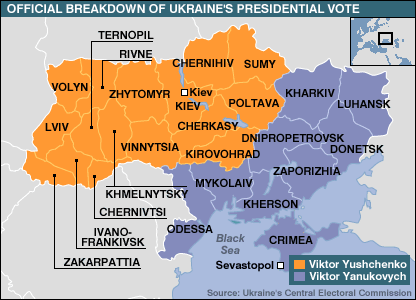
Russia's actions portend a new rise of the Russian Empire, an empire built on a state monopoly of oil and gas resources. On some level such an empire already exists with Russia's dominance of the breakaway states and their influence in Belarus. The union of Russia and Belarus could be seen as a Russian land grab with the smaller Belarus to be swallowed by the larger Russian nation. Russia's threats on NATO membership against Ukraine show more of these imperialistic aims with likely half the country to be gobbled up in any future secession. On some level such secession would be necessary as it would provide a crucial land link to land-locked Transnistria, which is also a separatist state seeking Russian integration. By dividing Ukraine and annexing the eastern part of it Russia would pave the way for the annexation of Transnistria. Not to mention it would turn Ukraine into a land-locked country, diminishing the effect of its NATO membership. It is unlikely Russia wishes to see its Crimea port turned over to the United States. The annexation of Eastern Ukraine and Abkhazia would then give Russia an almost equal share of the Black Sea coast as Turkey. In this sense such a seizure could be not only a counter to NATO's land expansion, but their expansion on the seas as well. With Turkey, Bulgaria, and Romania all in NATO Ukrainian and Georgian membership would leave Russia boxed in by the West. While Turkey continues to control the Bosporous and Dardanalles straits controlling the other half of the coastline severely limits NATO's options in the area. If Russia can secure Turkey's switch to their side, a possibility if the AKP and its members are actually banned, then it would be NATO, not Russia being boxed in and having to work with the Russians in the area rather than the other way around. This would also destroy European hopes at securing their energy independence from Russia as Turkey and Ukraine were seen as the ideal substitutes for funneling energy through Russia.

It is in this light that the recent tension with Georgia becomes clear. Russia is no longer interested in simply halting NATO expansion east, but countering such moves with its own expansion to the West. A conflict with Georgia could be just the beginning of a move by Russia to gain more power over Europe.

Tuesday, May 13, 2008

Hezbollah turns attention inward

As Hezbollah continues to build up its forces in preparation for a likely battle with Israel, possibly as a result of retaliation for a revenge strike over Mugniyeh's death the military situation has shifted to internal conflicts in Lebanon.

In the past few days Hezbollah has been fighting government parties in Lebanon. The conflict was sparked after the government pledged to investigate a Hezbollah telecom network and removed the chief of the Beirut airport. Nasrallah declared the tough action was a declaration of war by the government. Since then Hezbollah has been playing a game of chess with the government parties decisively trouncing them in every encounter. They started by seizing West Beirut and turning it over to the Lebanese army. Immediately following that it spread east, south, and north. Hezbollah's allies also began to engage in conflict with government parties without Hezbollah's intiative. The killing of several Hezbollah members in a Druse area near Beirut brought fighting to that area as well.

In the Druze areas Hezbollah's allies were able to take control and like in Beirut turned it over to the army. While the possibility of revenge killings has been raised one of the bigger uncertainties is the Christian population which continues to stay out of the conflict. Aoun and his Free Patriotic Movement are one of the big Christian militias and are allied with Hezbollah, Christians dominate East Beirut and are a major portion of the population. So far all conflicts have been between Muslim sects, with Christian groups largely staying out. The conflict so far has also exposed weaknesses of Lebanon's military which has seen its brokered agreements violated and has largely stayed on the sidelines.

Only on Tuesday several days after did the army declare it was ready to use force against militants, after Hezbollah achieved most of it successes. While the hostility has abated since the declaration Hezbollah has continued its political campaign against the government, calling for the resignation of the Prime Minister. The true magnitude of Hezbollah's victory is how those militias allied with the government are now being disarmed by the army as Hezbollah remains strong. Hezbollah succeed in taking key areas around Beirut and elsewhere in Lebanon, proving it is capable of overturning the government at the drop of a hat. An offer by President Bush to help arm the Lebanese military in order to disarm Hezbollah could reverse the calm in Lebanon, however if the government receives it.

Lebanon's government is also showing defiance as it says it would not "surrender" to Hezbollah's political demands. However Hezbollah continues to show its strength as a political force with its ongoing blockade of the Beirut airport. The struggle between the government and the opposition has left Lebanon paralyzed. An Arab League delegation is set to hold crisis talks to resolve the standoff, but with both sides likely to stick to their demands they could be left in a static position.

A failure to reach a compromise on the standoff could lead to renewed conflict, especially if Lebanon's government takes any move to receive arms from the United States. The government is also faced with the stark situation of dealing with the blocking of Beirut airport. As Lebanon's most crucial airport the Hezbollah civil disobedience campaign can only last for so long before it is seen as a hindrance. Should the police or army take actions to free up the airport Hezbollah will be provided with additional incentive to strike hard at the government.

Additionally Hezbollah's campaigns in east of Beirut against Druze strongholds has given Hezbollah strategic control of an important area of Lebanon. By taking the mountains east of Beirut Hezbollah has managed to link its stronghold in Southern Beirut with the Bekaa Valley, where it's greatest military strength is posted and where most weapons it brings into Lebanon pass through. It has also given Hezbollah strategic control of the major highway linking Syria and Lebanon. Control of such crucial territory would be a boon to Hezbollah in any conflict with Israel. As such Israel is given greater reason to launch the first strike, especially if Hezbollah tries to remove the government. This could be seen as preparation for an attack on Israel or at least the dangerous growth of strength of Hezbollah. Israel may consider a strike now to be the best way to avoid a more serious conflict later. However, any such attack would ultimately bring in Syria, Hamas, and Iran.

In the end the conflict in Lebanon could grow to a Middle Eastern War if the situation fails to subside.

Wednesday, April 16, 2008

What now of Taiwan?

Several weeks ago Ma Ying-jeou of the KMT defeated Frank Hsieh of the DPP for Taiwan's presidency in a landslide. With the results of the legislative elections where the KMT gained a three-fourths majority, the KMT has emerged with an absolute victory. As a result Taiwan is likely to pursue far greater integration with China, however until Chen Shui-bian leaves office there are still questions of what will happen.

Since the crippling defeat the DPP has been in a political crisis. Frank Hsieh having been the chairman of the DPP has withdrawn from his post effective upon the appointment of a new chairman on May 18th leading to disputes within the party. In particular there's a battle going on between various factions within the party and a battle of new guard versus old with several going after Chen Shui-bian among others. Even Frank Hsieh has come out to criticize Chen Shui-bian, blaming him for the huge losses and condemning him for hypocrisy on corruption. Hsieh and other voices within the party are calling for a re-evaluation of the party's pro-independence line. If a compromise on all these issues is not agreed to it is likely the party will become deeply divided and may even split completely.

Of particular danger to the DPP is the slew of court cases against senior leaders. Ma Ying-jeou managed to avoid a conviction over corruption charges prior to the election, but the DPP may not be as lucky. Several major officials, among them Vice President Annette Lu and Frank Hsieh, who faces a host of charges. With the party torn by corruption scandals, infighting, and a major electoral defeat they have enough reasons to worry about their future political survival.

For pro-independence forces in the party the overwhelming victory of the KMT is beyond dangerous. During the campaign Chen Shui-bian and Hsieh drew parallels between Taiwan and the recent events in Tibet. They also painted a vote for Ma as akin to a vote for surrender to China and accused Ma, who had held a U.S. green card, of being disloyal to Taiwan. All of this was intended to paint the election as a life or death situation which could lead to the destruction of Taiwan or at least the loss of its independence.

Following the victory of the KMT there was immediate talk of expanded ties with China including daily direct flights between Taiwan and the mainland, the creation of a common market, and, the biggest prize of all, a peace agreement with China. However, the DPP has rejected deepening ties with China as they fear it will only end with the loss of Taiwanese independence.

It is of some note then that recently pro-independence news sites and members of the DPP have begun playing up fears about the incoming KMT administration. Of some note is a recent article which argued an attack by China on Taiwan is likely after Ma Ying-jeou takes office. The argument seems to be that Ma will not have fully organized by then and he won't be strong enough in favor of reunification. As such the author of the article says an attack on Taiwan is likely after Ma takes office. A trip by the Vice President-elect to China also led to criticism as some DPP members said the Chinese government used it as a propaganda tool to promote reunification and treated Taiwan like a province. Another article accused the KMT of scheming together with the U.S. and China to prevent independence and make Taiwan a dependent regime.

Such scaremongering also comes in light of apparent difficulties in the transitional phase between Chen's administration and Ma's. Ma has been playing up the idea of negotiations on the basis of the 1992 consensus where China and Taiwan agree there is one China but with different interpretations. However, following discussions with the Chen administration it was reported Chen and Ma could not come to an agreement on what the consensus meant or if it even existed. Chen condemned all of Ma's proposed policies declaring China wasn't to be trusted and dealing with the 1992 consensus could lead to Taiwan falling into the "one China" trap.

So what measure could be taken to prevent what Chen and others in the DPP consider a possible trap to end the sovereignty of Taiwan? It's possible Chen has already let slip a possible course of action when in talking about proposals to resolve a dispute of the management of elections he mentioned the possibility of declaring martial law. While he ultimately stepped back from that statement the fact this was proposed to him and he even considered the possibility leads one to wonder if this is how he intends to prevent Taiwan from "falling into the 'one China' trap". Following the election Chen deflected rumors that there was a plan to impose martial law or prevent the entrance of the KMT government insisting he was dedicated to a peaceful transition.
However there have already been accusations and word of hindrances being made to the transition. One potential problem is the planned mass resignation of the government before an agreement can be reached on Ma's administration. Not only that but the shifting of diplomatic personnel indicates Chen is trying to improve the DPP's standing in foreign policy. The end result of the combined efforts would be an obstruction of the incoming KMT administration. What's more having the government under the control of the Cabinet Secretary-General in the interim period could ease the imposition of a martial law situation. If there is still no agreement on how to form the new government and other issues remain outstanding it's possible then a martial law situation will arise.

On this note it might be of interest that Frank Hsieh has called for the formation of a shadow cabinet following his resignation, which would be the first time such a measure has been taking by a losing party since elections started in Taiwan. Hsieh's shadow cabinet is likely to include officials resigning from their posts around the same time and as this would take place before the transition of power there remains the possibility of Chen declaring martial law and having the Cabinet Secretary-General make the shadow cabinet an interim government. One potential justification for a declaration of martial law would be an ongoing investigation into the Taiwan Goal controversy. The controversy involved a private corporation secretly established by Chen's administration to use public funds to make arms purchases for Taiwan. KMT lawmakers have accused the DPP of launching a "green terror" prior to the transfer of power by trying to force journalists to reveal their sources for the story. Taiwan's Defense Minister refused to comment on whether lawmakers could be investigated as well.

Chen himself has a very strong reason to stay on as President as it is widely reported he will immediately be indicted and tried for corruption after he leaves office. It would also not be the first possible action by Chen to preserve himself in power through illegal means. The attempted assassination which is widely believed to have handed him a narrow victory in Taiwan's 2004 elections was suspected of actually being a staged event to keep himself in power. While the official investigation has not verified this claim, if it's true it would not be a stretch for Chen to preserve his place in power by declaring martial law. In fact the corruption charges likely to be made against him and much of the DPP leadership along with what could end as the dissolution of the party provide plenty of reasons for preventing the KMT from taking complete control of the government. Indeed not even the CCP has a three-fourths majority. The disintegration of the DPP could be the onset of a de-facto one-party state under the KMT, blocking such an action might be the ultimate justification for preventing Ma's accession and preserving Chen's position as President.

The incentive for Chen to declare martial law and block the results of the elections is overwhelming as one prosecution official has said, "We will indict Chen after he leaves office unless other factors or barriers intervene first."

In the end such an action, if carried out would only invite the military reaction of China and completely eliminate Chen's Western support. The only way to prevent an attack would be the declaration of a nuclear deterrent. On this it is interesting that several years ago Taiwanese lawmaker accused Chen of developing a nuclear weapon. Reports in Chinese media later speculated that Taiwan had already restarted its nuclear weapons program in secret under President Lee Teng-Hui around 1996 based on comment from several Taiwanese officials.

While questionable these reports should not be automatically dismissed as Taiwan had a long-standing nuclear weapons program and their membership in Eisenhower's "Atoms for Peace" initiative. Under that program it's believed enough weapons-grade uranium for 1,000 nuclear weapons was sent to 43 countries. The fact Taiwan purchased a reactor from Canada that also had contributed significantly lead to India and Pakistan's successful nuclear weapons program and also unsuccessful programs launched in Argentina and South Korea there is reason to wonder how far Taiwan progressed. It's possible Taiwan already acquired weapons-grade material needed for a bomb and given a case last year of over a dozen pounds of weapons-grade uranium going missing in China it is not inconceivable for Taiwan to attain nuclear material today.

A very recent report which raised concerns was the accidental delivery of four nuclear missile fuses two years ago. Apparently the fuses had only been returned the week prior to the report. Two years could be sufficient time for Taiwan to have studied and been able to copy the technology there and possible incorporate into an unknown nuclear program. One serious question is how could such a mistake happen and some are asserting it was intentional. This is indeed a possibility. The United States military has taken a decisive turn towards positive cooperation with China rather than treating them as an enemy treating them as a partner. It's almost certain this is not supported by all voices in the military, some of whom may wish to see the U.S. more forcefully backing Taiwan. Such sympathies could be played to in order for Taiwan to attain some needed nuclear material.

A declaration of martial law by Chen Shui-bian to prevent unification with China would lead inexorably to a conflict with China and without being able to count on American support. As such Taiwan's only possible counter would be the development of nuclear capabilities to counter-act China's overwhelming military power. However, if such a step is taken it likely means the ultimate demise of the Taiwanese independence movement.

Monday, March 24, 2008

Middle East on Verge of Major War

Mugniyeh's death over a month ago has sparked fears of Hezbollah retaliation and it's being suggested that Monday may be the day when such retaliation comes or may be used to justify an oncoming attack. Hezbollah will hold a rally honoring Mugniyeh and the end of the mourning period of his death. They may use the moment to rally their supporters behind an inevitable war resulting from Hezbollah retaliation. Such a war could engulf all of Lebanon and may even spread to Syria and Gaza.

It should be of no surprise then that Syria has deployed some three divisions of troops on the Lebanese border, likely preparing for or anticipating a massive Israeli attack in Lebanon and maybe even attack against Syria. Other reports are saying the attack by Hezbollah may be done simultaneously with actions by Syria and Iran and may even include attacks by Hamas. The dangers of a war of such scale should not be underestimated.

While Iranian involvement would likely invite American retaliation, especially as it appears military action is again in the works concerning Iran's nuclear plans, it will probably not invite a massive war with Iran. Israel is likely to be incapacitated as it faces off against Syria, Hezbollah, and Hamas, while the U.S. will likely be facing difficulties in Iraq, and probably will not have sufficient resources deployed to launch a full-scale air and naval attack on Iran.

Such a conflict therefore will primarily involve Israel, Syria, Lebanon, and Palestine. However, this would likely be an intense and arduous conflict. Of particular notice is the stark advancement in Hezbollah's rocket arsenal. With an estimated 40,000 rockets and missiles Hezbollah would be able to launch a large-scale attacks against Israel well beyond the intensity of the 2006 Lebanon War. More notably is a larger number of these would have a reach of some 200 miles from north of the Litani putting almost all of Israel in Hezbollah's targets. When one considers the massive arsenal built up by Hamas and the inclusion of Syria's arsenal, which itself includes Scuds with far greater range, Israel could face a flurry of missile throughout the country.

During the 2006 Lebanon War Israelis in the North were forced into bomb shelters for weeks. In a renewed conflict the same situation would be repeated throughout all of Israel with Israel likely facing a military attack from Syria to retake the Golan Heights, which could pave way for a full-on invasion to force a concession out of Israel. Syria has armed itself with the latest anti-air and anti-tank weapons from Russia which combined with its military aircraft are sure to wreck havoc on Israel. Syria's push combined with Hezbollah's retaliation and the launch of a massive attack by Hamas might overwhelm Israel incapable of dealing with an endless onslaught of missiles as well as a military attack all designed specifically to strike at Israel's strengths. Faced with its most dire situation since the Yom Kippur War Israel may resort to extreme means including the use of nuclear weapons.

If Israel used nuclear weapons it would most likely be as a result of a crippling unexpected defeat and will probably be directed at the most important target imaginable, Damascus. Being the largest city in Syria and the capital it would be the most psychologically, politically, and militarily effective target. Wiping out the entire area with a dozen or so nuclear weapons would either send Syria into a crisis or force a peace.

While such a strategy could be effective in stopping a defeat it would only heighten Iran's concerns with Israel becoming only the second nation to use nukes in a conflict while the first is allied with them and both nations seeing Iran as the ultimate threat in the region. Iran is likely to seek out a major ally which will likely be Russia and Iran will probably push inexorably towards a nuclear weapon with Russia removing its opposition.

Of course, if Iran gets a nuclear weapon Saudi Arabia will ultimately seek to do the same in order to avoid relying on Israel or the United States. The nuclearization of the Middle East would mean the next Middle Eastern war would be an atomic one.

Wednesday, March 19, 2008

Israel preparing for conflict with Syria

The assassination of Imad Muginyeh, which Hezbollah has blamed on Israel, is expected to lead to an attack sometime past March 22, when the mourning period ends. In preparation Israel is beefing up security near Palestine and has put its troops near Lebanon on high alert, as well as advising Jewish and Israeli institutions around the world to increase security. The more frightening aspect of this is Israel's warning that apparently an attack by Hezbollah will lead to an attack on Syria. Their reasoning might be indications from intelligence that Hezbollah is planning revenge attacks alongside Iran and Syria.

It possibly for this reason U.S. ships have been lingering off the Lebanese coast over the past few weeks. A conflict between Israel and Syria is likely to invite Iranian retaliation and escalate into a war between the U.S. and Iran.

It appears Syria is already preparing for a conflict with Israel. Israel has reported that Hezbollah's military preparations have all been made and it is only a matter of time. Israel apparently intends to target the Western Bekaa valley and will likely attack other areas throughout Lebanon.

The most disturbing possibility is that Imad Mugniyeh may not have been killed by Israel, but in fact by Syria. In this case it would be Assef Shawkat the man who is suspected of having killed a Lebanse politician which resulted in the Cedar Revolution. He is reportedly leader of a hawkish faction which wants to go to war with Israel and is pro-Iranian. The implications are clear if he is in fact the attacker.

Shawkat may have killed Muginyeh knowing the response and planning to aggravate it so as to create the pretext for war with Israel. Whether he is doing this with the help of Iran or if its known among the Syrian government can't be certain. However, it seems likely Shawkat will indeed get his war.

Tuesday, March 18, 2008

Fallout from Kosovo looming

On Monday UN and NATO forces clashed with Serbs in Northern Kosovo after seizing a court in Mitrovica. Serbia has been endorsing attempts by Serbs in Kosovo to seize infrastructure in Northern Kosovo and ignore orders from Kosovo's central government. The most eerie comment to exemplify this came from Serbia's Minister for Kosovo who said, "We will protect you just like we protect the Serbs in Serbia," which would suggest this includes military force as the military of Serbia would surely intervene if a foreign country was attacking Serbs within Serbia.

There's no indication Serbia has yet gone to those lengths, but they may be headed in this direction in the future. They may not only be headed for military intervention themselves, but reportedly could end up pushing for Russian intervention. The fact Serbia is consulting with Russia on a joint response to the unrest is a clear example of the post-independent shift towards Russia already taking place. A shift toward the nationalists could be solidified without a nationalist as President and this would be a decisive push towards Russia.

After Kostunica's call for an election the issue of Kosovo will definitely become paramount in Serbia. Indeed his call may have been aimed at shifting the gears through electoral means rather than trying to reach an agreement with Tadic. A major success for nationalists would allow Kostunica to form a new government with Serbian Radicals and others, keeping the democratic parties in the minority. It is likely nationalists will portray the democrats as seeking membership in the EU without Kosovo while their goal is to join the EU with Kosovo. The fact Serbia's Radical party fared so well in the presidential elections should unnerve Tadic heading to parliamentary elections where nationalists have yet failed to net a majority. It seems even less likely for them to lose their majority under the present circumstances. The Western nations would have no room to argue whether Serbia's will is to push towards Europe and leave Kosovo behind it.

Beyond Serbia and Kosovo the implications in the Former Soviet Union are going to become an issue fairly soon. The Duma has announced what its official recommendation is likely to be as it concerns Abkhazia and South Ossetia, a request to initiate a process of recognition. While such a recommendation is sure not to be binding it does not rule out the possibility of its consideration. In particular it would mean Putin and the government most likely going against his party. However, at the same time the Duma gives the government some breathing by offering three scenarios for the breakaway republics:
  • Recognition
  • Transition to the so-called deferred status in bilateral relations with these territories
  • Actively develop more comprehensive cooperation including the opening of Russian missions and the right of tax-free imports of goods produced by enterprises with the share of Russian capital, operating in Abkhazia and South Ossetia.
Russia is making an attempt to paint Kosovo as a precedent already emerging by mentioning the crisis in Macedonia's government and the unrest in Tibet. The former is motivated primarily by Albanians in the Macedonian government who have called for improvements in some areas for Albanians in Macedonia and recognition of Kosovo. Albanians in Macedonia are one prominent groups in the Balkans feared to use Kosovo as a precedent for independence which is believe could also result in a merger with Albania to form a Greater Albania. However, such moves along with clear moves towards partition in Kosovo are likely to open up a larger can of worms with movements for a Greater Serbia and United Macedonia coming into play, even Greater Hungary.

Though, while Greater Serbia and Greater Albania actions are likely to emerge out of Kosovo, it's possible other irredentist ambitions in the region will not result in any real consequences. As it concerns Macedonia the resolutions of the name dispute with Greece, recognition of Kosovo, and induction into NATO could cool any ethnic tensions among Albanians in that country. Induction of Albania could complicate the inclusion of Kosovo into the state, though a partition of Kosovo might quicken it or create an effective union between the two.

At the same time the reverberations from Kosovo will be felt as the precedent gains momentum. At present it does not have the stark implications for the world it has been played up to have, but that is likely to wait on the actions of Russia and Republika Srpska, possible the Albanians in Macedonia. If any of them seek to capitalize on a precedent the push for independence around the world will only be aggravated further. The negotiations on Western Sahara could reach an end this year and Somaliland may also receive recognition. Taiwan's fate seems likely to be decided soon with the presidential elections. Cypriot elections have given renewed consideration to the Cypriot status, though a likely failure could push Northern Cyprus over the edge. Pushes by regions in Georgia could be helped by Georgia receiving a Membership Action Plan for NATO in two weeks, the push for a merging of Srpska with the Bosnia Federation by the EU could push Srpska to a referendum if Kosovo doesn't, though no matter what Kosovo's independence would be linked to it. In every case it seems the answer leads to conflict in the end.

The confluence of so many major events around the world each with broad geopolitical implications one can't help but wonder if this is occurring by design or is simply a bad run of luck.