Monday, August 11, 2008

Russia invades Georgia proper

Russian troops have now advanced from South Ossetia into Gori, taking control of the city. They have also advanced from Abkhazia to take Zugdidi and several other Georgian cities. Russia has reportedly pulled out of one of the towns taken in the new offensive. Georgian troops have also pulled back from Gori intending to hold Mtskheta which lies 15 miles from Tblisi.

Georgia fears Russia may be intending to attack and take the capital, ultimately to overthrow the government of Mikheil Saakashvili. This view about Russia's objective treceived significant support after the U.S. ambassador to the UN revealed a secret communication between U.S. Secretary of State Condoleeza Rice and Russian Foreign Ministry Sergei Lavrov during a Security Council meeting which has Lavrov calling for Saakashvili to "go" meaning be removed from power.

In addition to a possible advance on the capital Russia is also said to be planning an offensive against the Russian port of Poti. Poti is one of Georgia's two major Black Sea ports along with Batumi. At the same time Russia was expanding the bombing campaign against Georgia with as many as 50 Russian bombers operating Georgian airspace. Russia's fighters and bomber not only vastly outnumber the Georgian air force but are also far more advanced with the best Georgian aircraft being the Su-25 attack aircraft of which Georgia only has a few dozen. Should Russia decide to it could destroy much of Georgia's air force. The U.S. was also returning Georgian troops from Iraq who have now moved near areas held by Russian forces preparing for either a counter-offensive to block further Russian advances.

At the same time Ukraine is saying it may bar Russian ships which had gone from the Black Sea port of Sevastopol in Crimea. Ukraine is pressuring Russia to agree to a limitation on the use of force by Russian ships based in Crimea. For now Russia is basing the ships engaged in Georgia at the Russian port of Novorossiisk. However, it is unlikely Russia would let a barring of Russian ships from Crimea pass by unanswered though they would likely wait to act until they have dealt with Georgia. One possible option is to instigate a rebellion by pro-Russian Crimeans.

American Vice President Dick Cheney is warning Russia its actions in Georgia will not go unanswered and will seriously harm U.S.-Russian relations. Already there is talk of U.S. intervention. Any such intervention is likely to be meant as a means to prevent the toppling of Georgia's government and could involve the deployment of U.S. naval ships in the Black Sea as well as a limited deployment of American troops most likely in Tblisi. The implication being that any attempt to topple Georgia's government would lead Russia into conflict with the United States.

At the same time the conflict is becoming a major issue in the American presidential campaign. Barack Obama is still vacationing in Hawaii, which is likely to make him appear irresponsible in a time of crisis, while at the same time is heavily emphasizing diplomacy and negotiations with Russia rather than toughness. Their criticism of McCain is linking him to a lobbyist for the Georgian government, a political attack unlikely to gain significant traction. McCain is issuing a very tough response to the attack and he has in the past called for Russia to be expelled from the G8. McCain will likely use this to press his tougher foreign policy including his plan for a Community of Democracies to offset Russian and Chinese obstruction in the UN, his plan to increase considerably the size of the U.S. army, and revamping the CIA to a level relative to the OSS.

It is likely McCain will attempt to paint Obama as a sort of Neville Chamberlain calling for peace and diplomacy in the wake of a dangerous aggressor. This could resonate with voters as the conflict escalates further. Should McCain win the Presidential election it will likely move U.S.-Russian relations up to a more confrontational level.

Sunday, August 10, 2008

Abkhazia opens second front against Georgia

Abkhazia's President has sent 1,000 troops to the Kodori Gorge and called a general mobilization of its reservists. This follows a bombardment of the valley by Abkhazian forces and bombings by Russia. Signs of an invasion were being seen earlier when Abkhazia warned the UN observer mission to leave the gorge.

This in the wake of a temporary ceasefire and withdrawal in South Ossetia possibly to allow in humanitarian workers. At the same time Russia appears to be imposing a naval blockade on Georgia as well as deploying ships near Abkhazia to prevent incursions by Georgian ships. The massive increase of Russian troops in the area together with the mobilization by Abkhazia mean the second front will be even heavier than the last.

At the same time the ceasefire in South Ossetia may be buying time before its 2,000 troops in Iraq return to join the conflict. With significant Russian forces deployed in South Ossetia and Abkhazia the well-trained combat-experienced soldiers would provide a major boost to Georgia's efforts.

In the mean time Abkhazia has made sure there will not be any major lull in violence.

Saturday, August 9, 2008

Russia planning to launch massive attack

Numerous reports are talking about a force of about 4,000 troops coming by sea to land on Georgia's coast along with 6,000 troops planning on the ground. At the same time there are growing indications of a major impending assault on the Kodori Gorge as UN observers are being warned to leave the area.

Possibly in preparation for an offensive Russia appears to be setting up a naval blockade and is increasing bombing sorties into Georgia. The goal likely to dominate the sky, cut Georgia off from the sea, and ultimately make a major push into Georgia as a means of forcing a concession.

This could include an attack from Russian forces in Armenia, which risks brining Azerbaijan into the conflict. It is unlikely the U.S. will be able to remain out of this situation, though exactly how they would get involved remains to be seen. Deploying troops in Tblisi and Azerbaijan to prevent Russian advances is one distinct possibility.

Friday, August 8, 2008

Georgia invades South Ossetia

Right now Georgian forces are laying siege to Tskhinvali, the capital of South Ossetia. According to Georgia's president most of the separatist region is already under their control. However Abkhazia is sending troops to its border with Georgia and sending some 1,000 volunteers to South Ossetia to join volunteers from North Ossetia. This concern has lead to a stern warning from Georgia:
"We hope that the Abkhaz separaists will not undertake any steps that would compound the situation," Interfax news agency quoted Georgian Reintegration Minister Temur Iakobashvili as saying.

"We count on the Abkhazians not adding to problems in the region that could be deplorable for everybody," he said.
At the same time Georgia has a concern with Russia which has reportedly bombed a Georgian police post and sent troops into South Ossetia who clashed with Georgian forces outside Tskhinvali. Particularly disconcerting for Georgia would be a statement issued by the Russian Defense Ministry:
"The Georgian leadership has unleashed a dirty adventure," the ministry statement posted on its web site www.mil.ru said. "Blood spilled in South Ossetia will be blamed on these people and their associates. We will not allow our peacekeepers and citizens of the Russian Federation to be hurt."
It's possible Russia is already responding by sending in heavy armor. Russia is likely to take action alongside Abkhazia in response to Georgia's invasion.

Thursday, July 17, 2008

The Taliban's Revival and the Afghan-Pakistani crisis

Only a month ago Afghanistan's President Hamid Karzai threatened to send Afghan troops into Pakistan's tribal areas following increased incursions by Taliban militants from Pakistan into Afghanistan. At the time the Taliban had staged a major jail break in Kandahar and were beginning to surround the city. While a retaking of the city by the Taliban was averted it was primarily because the Taliban chose to retreat into other areas of the province then engage the superior ISAF forces. Now the potential for instability has arisen once more in the form of a U.S. military buildup on the Pakistani border. Though both Pakistan and the U.S. deny any buildup various sources on the border describe the deployment of hundreds of troops with tanks and helicopter flights in the area.

According to some reports the Chairman of the Joint Chiefs warned Pakistan the U.S. would act unilaterally to stop Taliban incursions if Pakistan doesn't act and army sources have been cited saying the border forces were put on red alert to avert cross-border incursions. This too follows a major coup for the Taliban insurgency in Afghanistan after they assaulted a U.S. outpost, killing nine U.S. soldiers and ultimately forcing the withdrawal of U.S. forces from the area, which immediately fell under Taliban control. It also follows up the recent bombing of the Indian embassy which Afghanistan accused of being carried out by Pakistani intelligence, as well as an assassination attempt on President Hamid Karzai. Afghanistan halted meetings with Pakistan in a response to the allegations.

NATO forces in Afghanistan have also been launching cross-border strikes following attacks from inside Pakistan. Some reports are indicating the Taliban are intending to spark a cross-border incident, possibly hoping to start a war between the two countries. Drawing Afghanistan and the U.S. into the tribal areas would allow the Taliban to inflict heavy casualties on the forces as well as distract them and Pakistan from its own activities in both countries. While the remaining Taliban forces around Kandahar are believed to have been expelled by U.S. forces the Taliban still controls a substantial portion of the province and could launch a major offensive against the city once more, especially if NATO and Afghan troops are tied down in a major conflict within Pakistan or against Pakistan.

Kandahar is crucial in Afghanistan as a major roadway. Controlling Kandahar would put the Taliban in a prime position to launch an attack on Kabul. Given their already substantial positions around Kabul, which is closer to the main Taliban sanctuary in the Federally Administered Tribal Areas of Pakistan, the seizure of Kandhar could pave the way for a major offensive on the capital. Helping this effort even further would the seizure of another important city in Pakistan, Peshawar. Peshawar is a crucial roadway into Afghanistan and is used to get many of NATO's supplies, it also has been put in serious danger by Taliban positions near the city. Some of these militants were repelled but the main Taliban forces remain and reportedly could take the city at any time which would not only be a boon to the Taliban insurgency in Afghanistan could pave the way for a future assault on Islamabad.

The main source of contention has been the newly-elected Pakistani government's tendency to sign ceasefires with the Taliban only to have the Taliban build up its forces for more major assaults in Pakistan and beefing up the insurgency in Afghanistan. Each time the Taliban comes back stronger and more capable than ever.

If the Taliban is seeking to spark a conflict between Afghanistan and Pakistan it would have no better opportunity than when the U.S. and Afghan forces are straddling the Pakistani border. However the consequences of this could be far broader in scope. A U.S. incursion, if intercepted by Pakistani forces, is likely to spark a border war with the country and India may also get involved in the situation with some suggesting Indian troops be deployed in Afghanistan. Indian involvement in Afghanistan would build up pressure on Pakistan and could increase the risk of an Afghan-Pakistani conflict starting a war between India and Pakistan.

Whether India gets involved or not it is unlikely China will not react to a conflict between the U.S. and Pakistan. However, they are more likely to threaten intervention and rattle sabres at India to prevent their intervention. Aside from building up troops on the Pakistani and Afghan border, naval movements in the East China Sea could also be used to increase the pressure.The threat of war with China and the danger of the Taliban using instability to seize both Pakistan and Afghanistan would likely be enough to bring an end to any conflict between the two parties.

While any U.S. buildup on the Pakistani border is likely just pressure on Pakistan's government to act against the Taliban the potential for a single incident to spark a major confrontation is high and the consequences of a broad and dangerous scope.

Wednesday, July 16, 2008

Russo-Georgian tensions heat up

In late June and July diplomatic and military tensions in the breakaway regions of Georgia have considerably increased. It began when bombings in Abkhazia late June led to the closing of Abkhazia's border with Georgia. This was in response to alleged Georgian involvement in the bombings which Georgia denied. Over the two weeks following tensions have escalated to an extreme level in both Abkhazia and South Ossetia.

In South Ossetia on July 4 a shootout between Georgian and South Ossetian forces left two dead and led to a military mobilization by South Ossetia. Both sides blamed the other for starting the clash. South Ossetia threatened that any further violence would lead to retaliation including the use of heavy weapons against Georgian forces. Georgia responded by reinforcing its military presence. Following the attacks in South Ossetia were a series of bombings in Abkhazia which led to four deaths. Abkhazia's response was to cut off all ties to the Georgian government claiming the act was Georgian state terrorism. Georgia said it was planned by Russian groups wanting to maintain the Russian military presence. Abkhazia's president also announced that Georgia had plans to invade the breakaway region earlier in the year.

However, tensions reached their highest pitch following the detention of four Georgian soldiers by South Ossetia. Georgia said it was planning an operation to free the soldiers, though the soldiers were released before the operation could be undertaken. Despite this Russia sent its fighters into Georgian airspace to prevent Georgia's planned operation into South Ossetia. The admission led not only to the recalling of Georgia's ambassador to Russia, but also to Georgia calling an emergency session of the UN Security Council. South Ossetia said it was capable of preventing an attack by Georgia without Russia's help though claiming Russia had prevented a Georgian military operation by sending its fighters into Georgian airspace. Georgian officials have said if Russia violated its airspace against their fighters would be shot down and said it would reveal a Russian plan to seize the Kodori Gorge in Abkhazia by staging a Georgian attack on Russian peacekeepers.

In the midst of these tensions Russia's military has increased the combat readiness of its peacekeepers in Abkhazia including additional training and increasing security. A Russian military commander also warned on July 10 that Russia’s North Caucasian Military District would be ready to provide assistance to Russian peacekeepers in the event of a flare-up in tensions. This potential scenario was the subject of military exercises in the Caucasus by Russia. Georgia in response to the tensions has said it would be building up its military by 15% to 37,000 troops who would deployed to protect Georgian airspace as well as Georgia's black sea coast.

Adding even further to tensions have been parallel military exercises by Russia and the United States in Ukraine and Georgia. Russia's exercises are intended in part to prepare soldiers for supporting Russian peacekeepers in Georgia and Georgia has condemned the exercises as an aggressive show of force. The U.S. exercises included Georgia and Ukraine as well as Caucasian nations such as Azerbaijan, Armenia, and many NATO nations.

Another recent development in the region are talks about eventually admitting Abkhazia and South Ossetia into the Union State of Russia and Belarus. While the Union has not developed towards a federal state yet the fact this is the ultimate aim would make this a roundabout way for the breakaway regions to merge with Russia. A representative of the Union said the Georgian regions as well as Transnistria could join once they are recognized as independent. At first they would have to gain observer status and then ultimately graduate to full membership. This major shift from talk of incorporating the regions into Russia itself to having them join the Union State could be signaling the Union State's growing importance with Russia signaled by Putin's ascendance to the Premiership of the Union. This will ultimately leave Putin at the head of Russia's enlargement to incorporate other countries and breakaway regions in the Former Soviet Union.

While independence for Abkhazia and South Ossetia is one potential instigator of conflict between Russia and Georgia another may be arising with the presence of Russian peacekeepers in Georgian regions. Georgia has said that if a plan being offered by Germany on the conflict zone isn't accepted Georgia would take unilateral action against Russian peacekeepers. This would most likely be a formal demand for Russian peacekeepers to withdraw from Abkhazia which Russia previously warned could provoke a conflict in the Caucasus. This is a possibility mainly because Russia is unlikely to withdraw, which Georgia would then use to paint the Russian peacekeepers as invaders and may then take military action against them. Under those conditions Georgia would probably receive backing from the West in the event of an offensive against Russian peacekeepers, though likely not giving direct military assistance.

In this event Russia would claim Georgia was trying to resolve the dispute with Abkhazia and South Ossetia by force and recognize their independence. An invasion of the regions by Georgia would provide a perfect cover for Russian recognition and ultimately their incorporation into Russia's new empire.

Saturday, June 7, 2008

A prelude to a Middle Eastern War?

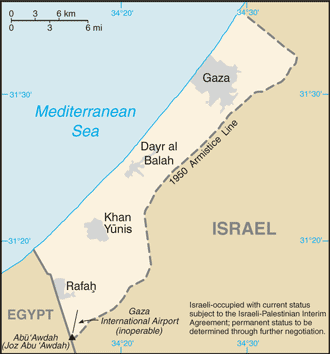
The momentum towards an invasion of the Gaza Strip is building as Olmert has suggested an attack on the territory could come within days. The plan may be for the IDF to take certain areas and used overwhelming airpower, avoiding an occupation. However, a massive attack of any kind on the Strip might lead to a full-on assault from Hamas which would ultimately necessitate tougher actions by Israel. This would likely lead to a call-up of the reserves and ultimately the occupation of a large portion of the Strip if not a return to full occupation.

According to certain reports Israel has offered to bring Fatah to power in the Strip, though Abbas, the leader of the party, has decided to pursue negotiations with Hamas on reconciliation before any operation. However, Abbas reportedly didn't outright reject the offer and is only pursuing negotiations to avoid appearances that Fatah is put in power by Israeli military action. This would seem to be clear given reports that Fatah-run Palestine and Israel have agreed to some elements of a peace agreement. Bush's expressed hope for a resolution of the Israeli-Palestinian dispute before the end of his term may come true if these events are any indication, however, it will most likely be as a result of Israeli military action and the usurping of Hamas.

At the same time talk is growing of imminent military action against Iran by the U.S., Israel, or both nations acting in concert. Bush is reportedly on the verge of a decision to strike Iran's nuclear sites and there may also be American plans for a limited strike against Iran's Quds force, specifically sites believed to be involved in training Iraqi insurgents, Hezbollah, and Palestinian groups like Hamas. Additionally there are reports that Israel may be considering a strike against Iran in the near future.

Any action taken against Iran could be in tandem with an invasion of Gaza. The sequence of events could involve a gradual escalation initially with U.S. forces attacking Quds forces believe to be supporting Iraqi insurgents and additionally backing it up as a move supporting Israel's actions against Hamas. The scope of Iran's retaliation would determine the events that follow. If Iran responds in a similarly limited manner it might not expand the conflict, however combined with an Israeli invasion of Gaza Iran could interpret the act as a more general act of war and respond much harder. The U.S. could use an escalation by Iran to justify its own escalation with attacks on Iranian nuclear sites in conjunction with Israel. However, Iran may then use this as a justification for a more concerted action against the U.S. and Israel.

The first possible avenue for expanding the conflict would be Hezbollah in Lebanon. This could involve the usurping of the Lebanese government as a means of preventing its disarmament or, more likely, acting on their promised retaliatory strike against Israel for the assassination of Imad Mugniyeh. On this matter Hezbollah has recently been reported to have fortified its positions in South Lebanon setting up strategic positions throughout the region. Hezbollah could take the opportunity of a strike on Iran or invasion of Gaza to punish Israel for their alleged involvement in the assassination.

In the event of a response by Hezbollah Israel has previously warned Syria it could become a target as a result. To this point Syria has been seeking more advanced technology from Russia to improve its ability to fight the IDF including surface-to-surface and surface-to-air missiles, advanced aircraft like the Mig-29SMT and Yak-130, and even Amur-class submarines, the export version of the Lada. Syria is also reportedly putting its missile forces under the command of an Iranian independent missile command which would include officers from Syria. Combined with the missile and rocket strength of Hezbollah and Hamas the combined force would overwhelm Israeli air defenses and allow for air strikes to be carried out in Israeli territory. Specifically if the force targeted Israeli air bases they could limit air sorties by the IDF which would also improve their chances of launching a ground attack with Syria aiming to regain the Golan Heights and perhaps looking further to force a concession from Israel through an invasion of Israel proper.

Another option for Iran to expand the conflict is in Iraq where it could foment greater violence in Shia communities but also could include another option. This would be an attack jointly with Turkey in the Kurdish north. Among the issues Turkey and Iran worry about one is the Kirkuk issue which, while Kurds have expressed openness to a power-sharing agreement instead of a referendum, they have also threatened to impose a vote in Kirkuk, that would lead to the oil-rich province joining the Kurdistan Region. Upcoming provincial elections have increased the tensions more by dividing Kirkuk into electoral districts, which Kurds claim will lead to partition. Another incident on Thursday added to the dispute over Kirkuk this time concerning its oil fields when Kurdish security forces seized the Khurmala oil field and blocked workers from the field. Oil ministry officials deemed the move irresponsible and brought back the workers with Kurdish forces leaving on Friday.

In the wake of these developments is official acknowledgment from a Turkish general that Turkey and Iran have coordinate strikes on the PKK in Iraqi Kurdistan and share intelligence on the organization. At the same time Iranian forces have resumed cross-border attacks against the PKK including a brief incursion into Iraqi Kurdistan. Earlier in the week Turkey sent additional troops to its border with Iraq to fight against the PKK. In Turkey the ruling party received a bad omen for the court case on closure of the AKP with the court's decision to annul its lifting of the ban on wearing headscarves in universities. Seen as an indicator of the result of the closure case it could mean the AKP will be shut down and its members banned from politics. While there's a possibility they will ultimately form a new party the case may lead to a new general election with the AKP suffering from the lack of Erdogan's leadership. The CHP and MHP would likely gain more control in the assembly and may even gain the strength to form a government. Both parties are more anxious about the PKK and have frequently accused the AKP of being soft in Iraq. An invasion would almost be a certainty under a secular-led government, especially if it included the nationalists.

While Kurdish officials have said they're opposed to the PKK's attacks they have also condemned Turkey and Iran for taking action against them, but refrain from doing so in their stead. As a result it's likely both countries consider the Kurdish government's committment to stopping the PKK half-hearted if not a meager ploy. Iran could launch an attack on the PKK base in Mount Qandil with significant Turkish support if not a joint assault. This would be to further complicate U.S. action against Iran as they would be hesitant to act against the Turks, but would not want to tolerate an outright invasion of Iraqi territory by Iran.

The only choice the U.S. would have in the wake of such a decision is to up the ante even more and launch more strikes on Iranian forces. Iran however would also be able to up the ante by expanding its area of action even more. Iran has trained its air force for potential long-range strike missions including night-time aerial refueling over the Mediterranean Sea. While some have suggested this would be in preparation for an attack on Israel if Iranian aircraft were operating from Syrian bases as they have in the past then the more likely is that the goal would be to launch a strike against American bases in Europe. Iran's cooperation with Turkey against the PKK could lead to an accommodation where Iran is able to use Turkish airspace. In addition to operating from Syria Iran would, with aerial refueling, be able to strike American bases in Southeastern Europe including bases in Romania, Bulgaria, and Greece. In the past the bases in Romania and Bulgaria have been cited as possible launching points for strikes on Iran.

This all depends on how far Israel is willing to go in Gaza and whether they or the U.S. use it as an opportunity to hit Iran or whether Iran or Hezbollah use it as an opportunity to strike Israel. In that case an invasion of Gaza could be little more than the beginning of a broad regional war which would escalate tensions with Russia and even lead to them siding with Iran. Israel should tread carefully for risk of igniting a conflict beyond their control.