Saturday, January 26, 2008

Kosovo Precedent: A Pandora's Box

Yet another vague allusion to the independence of Kosovo has been made by Kosovo's government. Kosovo's Prime Minister declared independence is "an issue of days" and, "Kosovo is ready. we will proclaim independence very soon." Of course, such comments have become common place, but with the second round of Serbian presidential election fast approaching it is likely this isn't more blustering by Thaci. How things play out in Kosovo depends strongly on who gains hold in the elections for Serbia's next President. Results from the first round give a good indication:

Tomislav Nikolić (Томислав Николић) Serbian Radical Party (Српска радикална странка) 1,646,172 39.99
Boris Tadić (Борис Тадић) Democratic Party (Демократска странка) 1,457,030 35.39
Velimir Ilić (Велимир Илић) New Serbia (Нова Србија) 305,828 7.43
Milutin Mrkonjić (Милутин Мркоњић) Socialist Party of Serbia (Социјалистичка партија Србије) 245,889 5.97
Nikolic is sure to get votes from the Socialists and support from New Serbia voters may also swing to Nikolic. The strong support for nationalist politicians does not bode well for Tadic as his last victory was gained in a field more heavily divided and one where voters showed clear support for democratic candidates. Also in doubt is whether Kostunica will pledge his support for Tadic. One report says Kostunica placed a condition on any support he gives Tadic:
In exchange for his support, according to Belgrade daily Blic, Kostunica said Tadic must oppose the planned EU mission to Kosovo, unless the UN Security Council adopts a new resolution authorising it. In return, Tadic wants the prime minister to back the signing of a Stabilisation and Association Agreement (SAA) with the EU.
However, it seems unlikely Tadic will actually follow through on this agreement. Kostunica probably does not want a simple condemnation of the EU force, but hinging the SAA on the refusal of such an agreement:
The Democratic Party of Serbia (DSS) is calling for a tougher policy regarding the EU -- it does not want the SAA to be signed if the EU deploys that mission to Kosovo, without prior UN approval. The DSS says an EU mission to Kosovo would violate Serbia's sovereignty.
These are probably not terms Tadic will agree with. In the event Tadic signs the agreement over the objections of Kostunica, it is possible Kostunica will simply reject Tadic and possibly back Nikolic. Tadic will then be left with little chance of winning the second round of elections, chances already diminished based off the outpouring of nationalist support.

A Nikolic win would set events on the worse possible course. Kostunica's party would likely switch its coalition around to the Serbian Radicals, forming a strongly nationalist government. It is unlikely the EU will waver from its support of Kosovo no matter the outcome since Germany's foreign minister has already declared the international community can not "prevent" independence. Given Kostunica's warnings to the European Union about supporting Kosovo's independence, this probably will mean a shift away from the West and towards Russia.

Potential for instability expanding beyond Kosovo remains strong with the potential for a Greater Albania situation. There are even Albanian political organizations in the Balkans circulating maps showing an Albanian state encompassing Kosovo as well as territories in western Macedonia, parts of Greece and Montenegro. This likely includes areas of Serbia outside of Kosovo with Albanian populations.

Albania's government has been very accommodating for Kosovo, including allowing them passage to their Adriatic port. The possibility of merging an independent Kosovo with Albania has been raised on many occasions, but it's feared such an outcomes will mean rebellions in several Albanian areas seeking to merge with Albania.

To the side is an image of what such a Greater Albania would look like, with Albanian majority areas in purple, though in Greece it is unknown as minorities are not recognized. Despite few areas outside of Kosovo and Albania having a majority Albanian population, essentially every territory considered to be part of historic Albania is meant by Greater Albania. If such territories did merge with Albania ethnic cleansing of non-Albanians could follow either through voluntary abandonment or violent excursion. Such a scenario would be the makings of a new Balkans War.

Alongside this Russia's Foreign Minister is escalating the rhetoric around Kosovo:
It will set a precedent for several territories, not only Abkhazia and South Ossetia, but - according to our figures - for some 200 regions in states around the world. If we allow someone to do something, many others will expect the same treatment.
However, this statement was quickly backpedaled on according to news media, but his statements appear less like a denial, and more like spin:
The Russian leadership has never said that after the recognition of independence in Kosovo we would immediately recognise the independence of Abkhazia and South Ossetia.
This is true, Vladimir Putin and other leaders have never directly stated they would recognize the independence of Abkhazia and South Ossetia and at no time did they say they would do so immediately. He then takes an even more ridiculous spin on the situation:
Lavrov said "there is nothing more untruthful" than the idea that Moscow was waiting to use Kosovan independence as a pretext "to start recognising all and sundry. There could be nothing less true."
Of course, this is not denying any plans for recognition, but stating only that Moscow does not want Kosovo's independence because it can be used as a precedent. His comments become much more clear from there on:
The precedent will be created not because we want it but because it will be objectively created...because justice is an understanding that drives people. If someone is allowed to do something, many others will expect similar treatment.
In other words, Russia doesn't want Kosovo to get independence and they aren't planning to recognize Abkhazia and South Ossetia as a response, but when Kosovo does get its independence the Abkhaz and Ossetians will expect to be recognized and so Russia will have no choice but to comply. Whether Russia does recognize the territories may depend on Georgia refusing to agree to a non-use of force agreement over South Ossetia and Abkhazia. Georgia is unlikely to agree as they believe the agreement as Russia proposes it treats South Ossetia and Abkhazia as countries separate from Georgia. It is also unlikely Russia will be willing to change this to imply the territories are part of Georgia.

Russia is not the only nation which is likely to exploit the precedent as Armenian officials often draw similarities between Nagorno-Karabakh and the Kosovo.

Such veiled comments seem to indicate the intentions of Russia and Armenia are ultimately to use Kosovo's independence as a precedent for breakaway regions, which are likely to ultimately merge with them. A merging of Albania and Kosovo may increase irredentist ambitions alongside ambitions for independence. Such a precedent could soon engulf Europe, Africa, and Asia in a tidal wave separatism ending with the possible dissolution of several states like Belgium and Somalia. Borders would be redrawn at a rapid pace resulting in countless conflicts. When the smoke clears, while numerous conflicts will likely be resolved, the path will be laid for a broader and more dangerous conflict. A conflict which could end up engulfing the whole world.

Tuesday, January 15, 2008

Kosovan Independence, Serbian Elections, and a Resurgent Russia

While speculation is rife about when Kosovo will gain its independence Kosovo's leaders are claiming it is quite imminent:

Kosovo’s new Prime Minister, Hashim Thaci, has said his homeland’s independence will be declared very soon.

While refusing to give an exact date for parliament’s expected proclamation of Kosovo’s statehood, Thaci told media on Sunday that “independence is only awaiting the procedural and ceremonial aspects of declaration.”

When exactly this means no one but those who already know can tell, but this statement was echoed by Kosovo's Speaker of Parliament:

The Assembly of Kosovo is approaching the moment of declaring independence, its speaker said on Monday afternoon.

Jakup Krasniqi, the new Speaker of the Kosovo legislative, told media that “the Assembly members are aware the declaration will take place in a very near future”.

Of notable interest is this:

He said that “the Assembly will hold preparatory consultations with President, Fatmir Sejdiu and Prime Minister Hashim Thaci before it proceeds with the proclamation”.
Perhaps these are the procedural and ceremonial aspects Thaci is talking about. Surely any declaration of independence would have to go through the Kosovo Assembly and Kosovo government. All the same none of this provides any timeline, though it is speculated to happen sometime after Serbian elections on the 3rd of February, the expected runoff election. The delay is mostly on the part of the West seeking to avoid disrupting the elections in favor of Nikolic of the Serbian Radical Party. However, whether this will actually take place as planned is unknown. It's possible Kosovo will not wait for the runoff election and declare independence immediately after the first round of elections.

Expectations in the West are largely naive and arrogant. Slovenia, holding the EU presidency, has offered Serbia candidate status for the EU. This is in keeping with the aspirations of Serbia's government. Of particular importance is the signing of the SAA agreement with the EU, slated for January 28. However, a Serbian resolution has said any agreement signed must respect Serbia's territorial integrity and it's unlikely the EU can be honestly considered to be respectful of Serbia's territorial integrity when they, alongside the U.S., are the ones planning on Kosovo's independence, which all Serbs would consider a violation of their territorial integrity.

How this plays out depends on the reaction of the Serbia public. The European Union and many countries in the West assume Serbia will simply lay over and play dead as it were with regards to Kosovo. In fact, this is exactly what they're banking on. The West wants Serbia to take the possibility of EU membership and ignore Kosovo's independence, thinking Serbia would have to be foolish to reject the embrace of Europe. Before this nations eagerly accepted EU membership and the EU members are now asking who should be held back and who should be let in. Never once had it been considered a nation may not want to join the EU.

Serbia, however, actually does want to join the EU all things considered. In a sense, Serbia would be like the abused child which, after being beaten ruthlessly by his parents, rushes back into their arms at a moment's notice giving the perpetual benefit of the doubt. Only problem with this is if Serbs are not so easily tricked by the EU. The crucial questions here are simple: Will Serbia's citizens look at the SAA as a sign of hope as the West is asking, even demanding, them to? or Will they be offended by the idea of the EU believing they'll rush into its arms despite being them plotting to dismember the country? The fact this move by the EU seems to be geared at improving Tadic's re-election chances may damage him in the end, especially since this reflects the EU's belief Tadic will stand aside and let Kosovo be taken from Serbia with no real objections.

Inevitably Nikolic is going to try and paint Tadic as a pet of the West running around like a dog barking and growling at them, but always rolling over when commanded. While Serbs favor joining the EU, it is not certain they'd like the idea of doing so at a time when the EU is trying to take away Kosovo. In this way the EU's push towards membership for Serbia may actually cause a backlash against them and increase support for Nikolic. If Kosovo declares independence beforehand this makes it even more likely. In fact, even without this it has been suggested Tadic may not be able to win:

Thursday’s edition of Blic daily quotes a survey carried out by the CeSID think-tank which says that Tadic can beat his likely main rival, Tomislav Nikolic of the ultra-nationalist Serbian Radical Party, only if all the parties in the governing coalition as well as the opposition Liberal Democratic Party back him in the second round.
Kostunica's party may choose against backing him and if they should back Nikolic, it creates a problem with Tadic's bid. His only recourse would be to break his coalition with Kostunica and dissolve the parliament, which might ultimately reflect more negatively on him. However, not acting may insure his defeat. This is not precluding the possibility that other parties may not back him. In the end, if Tadic loses Kostunica is sure to forge a new government with the Serbian Radicals. Westerners in favor of independence have made some pretty ridiculous conclusions about the events.

In all the imperial hubris one would expect from the 19th Century it is believed if Tadic wins Serbia will move on a glorious path towards peace and prosperity, by joining the European Union naturally, but if they choose Nikolic, Serbia will experience isolation, condemnation, and fall to the wayside, never mind Kosovo will suffer too even if there is no conflict. What is forgotten in all of this is the role of Russia.

Serbia's Kosovo Ministry Secretary of State Dušan Proroković made the stakes clear for the West when he said "Serbia would be forced to turn towards new strategic partners, countries that support its territorial integrity" if the West backed Kosovo's independence. This most likely means turning towards Russia, which is already in the works.

Gazprom's growing natural gas and oil monopoly is one of the most poignant signs of Russia's return as an imperial power. They've successfully used their hold on natural resources to force concession from neighboring states. While some in Serbia object to the idea, others would want to go one step further and join the Union of Russia and Belarus, effectively promoting unification with Russia. Impractical as it may be it's quite possible Belarus will be allowed to join the CSTO and EurAsEC as an alternative to the EU. In this respect it's interesting to note the growing integration of the organizations such as the formation of a customs union between Russia, Belarus, and Kazakhstan. More recently the CSTO secretary general announced plans for a Shengen-style agreement for the CSTO and EurAsEC. An expansion of both bodies to include Serbia can not be ruled out and such an agreement would be extremely beneficial to Serbia.

The CSTO is also showing a great unity in military actions such as recent exercises which, despite denials, appear to be aimed at Azerbaijan. In the event a conflict should erupt over Nagorno-Karabakh and Armenia comes under attack they can call up the collective defense obligations of CSTO member states in order to act against Azerbaijan. Which makes Serbian membership a more disturbing move, especially as Albania, Macedonia, and Croatia all look set to join NATO. Albania, especially is troubling if they should unite with Kosovo at some point, because it would effectively make any attempt to resolve that conflict a war between the U.S. and Russia.

However, one thing is certain and that is Kosovo's independence may push Serbia into the growing sphere of Russia's influence. A push that could set the U.S. and Russia on a future collision course.

Friday, December 28, 2007

Could Turkey Unite Iraq?

A New York Times story published on December 23rd has suggested U.S. support for Sunni Awakening groups might be increasing the chances of civil war in Iraq. The Awakening groups have grown to possibly 80,000 troops and may soon reach 100,000 troops overall. Iraq's government is concerned this large force may end up being used against it. However, there is another possibility that the Sunni Awakening groups could end with a new united Iraqi government and army. Turkey could provide the perfect catalyst.

Turkey has been launching even more attacks on Northern Iraq. The continued bombardment of Northern Iraq, which has just begun increasing could be a sign that Turkey's building up in preparation for a full-scale invasion. A recent attack in Istanbul blamed on the PKK may provide even stronger incentive for Turkey to invade Iraqi Kurdistan. If Turkey actually does invade the Kurds in the north are likely to fight back. A major war breaking out could also draw Iran into Iraq.

In this event several groups such as the Awakening militias and Moqtada al-Sadr's forces could rush to fight alongside the Kurds. After this it's likely Iraqis will rally around one of the major leaders in among them and forge a new government, toppling the Maliki government backed by the U.S.

Al-Sadr appears to be grooming himself for just this possibility getting deep into Islamic studies, eyeing the possibility of becoming an Ayatollah. Becoming such a religious leader would allow him to challenge his rival al-Sistani and his Badr Brigade. Al-Sadr has one strength in his Iraqi and Arab heritage, compared to Sistani's Iranian birth. By establishing himself as legitimate religious authority al-Sadr would be able to build his movement even larger and become a true national leader.

To this end it's believe his recent cease-fire is aimed at increasing the strength of his Mahdi Army. The aim is to provide an Iraqi militia modeled after Hezbollah, with significant religious, political, and military power. Sadr's aim may be to have an effective state within a state in Iraq. He is also using this time to weed out those responsible for sectarian killings in his militia. This will help to end the strife between al-Sadr and the Sunni population.

Al-Sadr has been reaching out to this very community in an attempt to form an alliance against the United States. The Awakening movements may provide the perfect chance for al-Sadr to forge an Iraqi national resistance against the U.S. occupation and Maliki government. If recent events are any indication it's possible the Kurds could also join up with the resistance.

Kurdish leaders have increasingly been in disagreement with the Maliki government over a variety of issues. Part of the problem is Kurdish oil deals signed with foreign countries, which Iraq's government rejects and has declared them void. In addition they've asked for a specific portion of the oil revenue in the country. There is also the contentious issue of Kirkuk and its referendum on joining the Kurdish region. Not only that but Iraq's government wants the Kurdish region to reduce its large army which is believed to be as large as 180,000 troops down to only about 25,000 troops which they claim is the limit given in previous agreements.

These issues all run the risk of ending the crucial support of Maliki from the Kurds, which would bring down the ruling government. While it's possible other factions will not agree with the demands of the Kurds either they may be willing to forge a coalition with them in order to remove the Maliki government.

U.S. support of Turkey's strikes in Northern Iraq is also threatening ties between the U.S. and the Kurds. A Kurdish leader over a week ago refused to meet with Condoleeza Rice. If Turkey launches an invasion of Northern Iraq it will most likely not be blocked by the United States, which has the likely possibility of alienating the Kurds completely who would look for new allies and may find them in Sadr and the Awakening movements. Sadr supporting the Kurds against Turkey and possibly Iran would also legitimize him before the Sunnis as well, making it more likely they would join them along with the Kurds. An alliance of the Kurdish Regional Government, the Awakening movement, and Al-Sadr could lead to the formation of a unity government with representation from Sunnis, Kurds, and Shiites with a large capable of army around 350,000 troops strong and one completely opposed to foreign interference and occupation, unfortunately for the U.S.

The Coming Wars of Independence

Kosovo's President condemned a Serbian resolution calling for cutting ties with countries that recognize Kosovo among other retaliatory measures. He referred to the resolution as a form of aggression and stated Serbia's policy has led to nothing but bloodshed.

Ironically it may be the case that Kosovo Albanians may end up causing bloodshed. The most likely area of conflict will be in Northern Kosovo. According to a member of the Albanian National Army his militia will send its troops into Northern Kosovo to defend Albanians as soon as Kosovo declares independence. They would also be deployed in the northern part of Mitrovica a city in Northern Kosovo. Apparently their troops have been spending the past few months on mobilization and logistics.

Should these troops move up north they are likely to come into conflict with Serbs in the north, some who are effectively Serbian police in the region. Serbs in the region are also strongly connected to Serbia with some even hanging pictures of the Serbian Radical party leader Vojislav Seselj who is on trial for war crimes. A very light presence of NATO forces exists in the north, around 500 German troops and 200 U.S. troops, a force hardly suitable for preventing a conflict between Albanian militias and Serbs.

According to one Serb in Northern Kosovo, Serbia has worked out a plan with Russia to send in Russian military advisers and weapons shipments to allow Serbia to retake the north. He says these advisers would easily be able to cross the border with Kosovo. In the south of Kosovo, however, several Serbs are planning to move up north to Serbia as soon as independence or have already left.

A mass movement of Serbs up into Serbia would be a disastrous outcome for Kosovo's government and Albanian militias seeking to protect Albanians in Northern Kosovo may clash with Serbs trying to protect Serbs from Albanian attacks. An attack would be all the justification Serbia needs to send its troops into Kosovo and spark a new war in the Balkans.

Of course, this will not end at Kosovo. There are dozens of frozen conflicts waiting for the Kosovo precedent to stake their claim to independence. In the Balkans there are several Albanian communities wanting to leave their countries and join a Greater Albania. On the other side there are also Serb communities wishing to break off and join Serbia, most notably Srpska in Bosnia. A push for independence by Srpska would mean an automatic war with Bosnia.

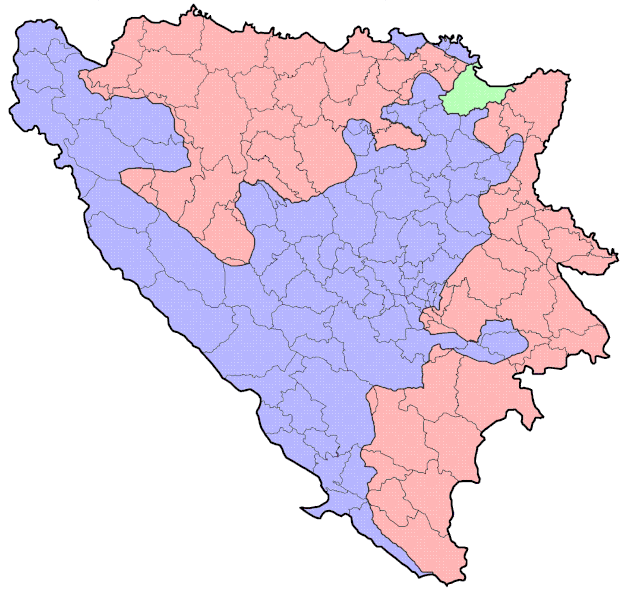
To provide the most notable example of how Srpska's independence means an instant war one has too look at how the country is divided:

Srpska is the red region and the light green region is Brcko District, which is shared jointly by Srpska and the Federation of Bosnia. Effectively, Srpska is cut in half by Brcko district an ethnically mixed region with slightly more Bosniaks than Serbs and a minority of Croats. More importantly is that Srpska's de-facto capital, Banja Luka would be cut off from Serbia and it has no sea access. This makes a war effectively required in order for Srpska to secede as part of its territory is also part of the Federation of Bosnia and is a crucial connecting point between Srpska's capital and the rest of the region.

Other than the Balkans some unrecocgnized states in the Soviet Union are likely to declare their independence. One notable case is South Ossetia which is saying in 2008 they expect to be united with North Ossetia in Russia. This would be seen as declaration of war by Georgia who would undoubtedly rush to invade the unrecognized state as well as Abkhazia and may draw Russia into the conflict.

Kosovo's precedent could be used by Northern Cyrpus as well. A senior Turkish Cypriot official claims 2008 is the last window of opportunity for a resolution of the Cyprus conflict and that the EU is prepared to go forward with a plan for recognizing Northern Cyprus's independence, which Cyprus is blocking.

In Africa the precedent of Kosovo is possible for Western Sahara and Somaliland. Western Sahara's Polisario Front has warned they'll resume war with Morocco if no progress is made in talks on its status. This would likely be done after Polisario's Congress next June or July. Somaliland may also be recognized next year as well which could mean a war with Somalia as Somaliland plans to extend itself to the former border of British Somaliland.

With other possible independence conflicts arising in Taiwan, Madhesh, and Kurdistan which is aiming for a Kirkuk referendum the year 2008 could be a year of wars.

Thursday, December 27, 2007

2008, a year of conflict

BBC News reporter Nick Thorpe wrote an article on the developing conflict in the Balkans. In it he suggested, "2008 could be the year the clouds of war finally disappear." I can't help but admire his irrational optimism.

His biggest mistake, like with all reports in Western Europe and the United States is the presumptuous belief that Serbia can be easily pacified and isn't going to fight what it knows to be a losing battle. Of course, Serbia doesn't have to defeat NATO to win the battle. Not being able to understand this is why there's a rush to recognize Kosovo and little worry about the consequences.

One of the most foolish and possibly dangerous presumptions is that Serbia will give up Kosovo for EU membership. While President Boris Tadic is pro-European and would continue on the European path Vojislav Kostunica is a nationalist. Tadic's tacit approval of trading Kosovo for EU membership is believed to be why he scheduled a presidential election for January 20th. The EU's schedule for signing the SAA, a step towards entry talks, on January 28th is believed to be aimed at propping up Tadic before an expected second round of votes in the presidential election.

However, ambitiously propping up Tadic may due far more harm then good to the pro-European faction in Serbia. Kostunica has threatened to form a new coalition with the ultranationalist Serbian Radical Party which would command a majority of 128 seats, only two seats less than the current three-party coalition. If Kosovo declares its independence any time before February 3rd it could help the Serbian Radical Party's Tomislav Nikolic take the presidency where most polls show him and Tadic in a dead heat during the second round. A win for Nikolic is especially likely if Tadic appears willing to trade Kosovo for EU membership.

This would create a situation where the government is under the complete control of nationalists. Tadic's only chance would be to call a general election, however this might only serve to delay and could work in favor of the nationalists standing to gain off a declaration of independence by Kosovo. In interest of avoiding such a scenario Kostunica may refrain from taking sides until the presidential election is over and the new president is sworn in about two weeks later. In this case Kosovo may be able to gain two weeks without having to worry about reprisals from Serbia.

Tadic's conflict with Kostunica though, may have already been resolved after a resolution was backed by Tadic's party. The resolution calls for no agreement to be signed without recognizing Serbia's sovereignty and territorial integrity, implying that any agreement with Serbia must consider Kosovo as a part of Serbia. It also calls for stopping movement towards joining NATO. In particular Tadic suggested he would send in the Serbian army if Kosovo Serbs come under attack, though only with international support.

His willingness to do this is, however, in question and it's blamed largely on election politics. It's seemingly a shallow and transparent attempt at improving his poll numbers, but it could work all the same, presuming Kosovo keeps up its end in this bargain and does not declare independence until after February 3rd.

In this area Kosovo has already made its first big step towards independence:

Kosovo's two main political parties have agreed to form a coalition government which will lead the breakaway province towards independence from Serbia early next year, party sources said on Wednesday.
While both the President and Prime Minister have pledged to work with the EU and US, they've also declared independence is "weeks away" just last week. Regardless of when Kosovo declares its independence the EU and US all plan to recognize it. So if Tadic follows up an independence declaration from Kosovo by signing the SAA, it could kill his support in presidential elections, giving Nikolic the presidency. He would likely assume office around February 17th. Kostunica then would be free to abandon the current governing coalition and join with the Radical Party.

Thorpe is also dismissive of Srpska and a move towards independence by them. This in itself seems to be little more than wishful thinking. Srpska's president has actually stated he would call a referendum on independence is Kosovo was recognized. Controversial police reforms are being delayed until mid-February, right after the Serbian elections. Should Nikolic win the presidency and his party forge a nationalist government Dodik may decide to call a referendum on independence or, if blocked in this move, declare independence outright. Such an event will mean nothing short of war as Srpska is cut in two by the Brcko district belonging to both the Serb entity and the Bosnian Federation. Nikolic and Kostunica would rush to support Bosnian Serbs, reigniting conflict in the Balkans.

One potential outcome which could inflame Serb irredentist interests is a push by the newly independent Kosovo to join with Albania. A member of Kosovo's government has suggested this as an inevitable outcome of independence. Current Prime Minister Agim Ceku has also stated this as a possibility, particularly if Serbia tries to force secession of Northern Kosovo. What exists in Kosovo now is a partition in fact and in the event of independence Serbia could push the north towards secession, especially if there is violence against Serbs. Irredentism from Kosovo would further push Serb irredentism and encourage Srpska to secede from Bosnia and join Serbia. It also could push Serbia into conflict with Albania.

While it's unlikely Serbia would ever be paid off by EU membership and this has actually served more to enrage Serbs then pacify them the same can not be said for other Balkan states. Macedonia and Montenegro, despite having reason to worry about Albanian irredentism, both having ethnic Albanian communities, appear set for recognizing Kosovo. Macedonia will, however, benefit from an invitation for NATO membership in April 2008. Albania will also be given NATO membership and Croatia, which could be faced with problems of Serb irredentism incited by Kosovo's independence and has an ethnic interest in preserving Bosnia. Croatia could also see its EU talks sped up towards reaching a 2010 accession date. Montenegro, likewise could be put on the fast track for EU and NATO membership, with EU accession as soon as 2012, according to member of the European Parliament.

This would stand to make Serbia's position worse, but also open room for far greater conflict. A merger of Kosovo with Albania would likely take place after NATO membership and with all four as NATO members Serbia would be almost completely surrounded by NATO members, making almost any conflict in the Balkans a conflict with all of NATO. Serbia's only option would then be to join the CSTO thus making any war in the Balkans a war between the U.S. and Russia.

However, while the optimists will ignorantly seek to allay concerns about the Balkans seeing renewed conflict they tend to ignore the ramifications outside of Europe. Most prominently is the development in Russia:

" - In case of the unilateral recognition of the independence of Kosovo, Russia will be entitled to change its approach to the so-called unrecognized republics in the post-soviet regions - South Ossetia, Abkhazia and Pridnestrovie," the chairman of the Council of the Federation (upper chamber of the Russian parliament), Sergei Mironov, said on Tuesday.

" - If countries start recognizing Kosovo randomly, this will be the first violent change of borders in Europe after World War Two, and the consequences will be unforeseeable,” Mironov warned at a press conference in Moscow.

According to the political leader, this will mark the beginning of a domino principle and then it will be possible to raise the issue of the recognition of Abkhazia and South Ossetia, which broke away form Georgia.

" - In case of such a recognition of Kosovo, Russia will be able to say that it is free in its approach, including towards the so-called unrecognized republics of Abkhazia, South Ossetia and Pridnestrovie,” Mironov said, using the official short-form name of the Pridnestrovskaia Moldavskaia Respublica (PMR).

This follows a statement by the leader of the lower house saying such recognition would be looked at starting January. The timing can not be easily ignored and this is obviously a response to Kosovo's inevitable declaration of independence. It's end result is effectively expected, Russia will recognize Abkhazia, South Ossetia, and Transnistria. While Transistria's independence may be uneventful given President Voronin's trepid approach to Russia, Georgia has said recognition of Abkhazia and South Ossetia's independence would effectively be a declaration of war, something all sides have been preparing for since 1991 and especially since the Rose Revolution. What happens depends largely on Georgian elections scheduled for January 5th. Polls show a conflicting story with Saakashvili first in most and in some by an overwhelming majority among decided voters. He has also played things in his favor by putting forward a referendum on whether Georgia should join NATO. If Saakashvili can maintain his place in office it would be a serious blow to Russia and make a war in the region almost inevitable.

Fallout from Kosovo could go further into Taiwan which is also heading towards a likely war due to a referendum on joining the U.N. with the name Taiwan which both China and the U.S. see as provocation, despite the fact Taiwan will never make it into the U.N. Not only could Kosovo's independence and recognition help the pro-independence DPP win in the legislative and presidential elections another event may make this more likely. It all depends on a court verdict on Friday. If KMT candidate Ma Ying-jeou is found guilty and sentenced to 10 years or more or convicted on breach-of-trust he'll be unable to run for president. This will effectively guarantee a victory for Frank Hsieh of the DPP and could carry on to the KMT's performance in the legislative elections. Faced with the prospect of a DPP-controlled government, especially one with a two-thirds majority needed for changes to the constitution, and a successful referendum China may decide to launch an attack on Taiwan.

Suffice to say the clouds of war will probably not disappear, but instead darken and spread.

Wednesday, December 19, 2007

Turkey Ups the Ante in Iraq

Turkey has revealed that they recently launched two major attacks into Northern Iraq. One was an airstrike on Sunday and another was a small-scale incursion on Tuesday. The incursion involved about 300 troops. This is more than in a previous incursion earlier this month involving about 100 special forces and six helicopters.

It would seem Turkey's government is escalating its offensive actions in Northern Iraq more each time. Previously reports of incursions were scattered, often involving limited incursions and limited strikes lacking any coordinated action. Now the attacks seem to be getting more coordinated and strategic. This is possibly due to U.S. intelligence being funnelled to Turkey's military. Apparently this attack was actually approved by the U.S.:
The authoritative US daily quoted a military official as saying the US was "essentially handing (the Turks) their targets."

Further to the report, the unnamed official although denying that the US had given official approval of Turkish actions in Iraq explained that "(the Turkish military ) said, 'We want to do something.' We said, 'Okay, it's your decision'."
The Iraqi government, on the other hand, claimed the Turkish government did not inform them of the attack or consult them. This certainly offended the Iraqi government which has tended to tolerate Turkey's incursions in the past. All the same they took a relatively conciliatory tone in spite of the attack:

"We believe any unilateral actions to destabilise the situation will harm Iraq's interests and Turkey's interests at the same time," he said.

"But at the same time we fully understand and appreciate the legitimate security concern Turkey has over the PKK terrorist activities."

However, Turkey has not received the same kind of measured criticism from the Kurds in Iraq:

Massoud Barzani, leader of the autonomous Kurdish region in the north, condemned the assaults as a violation of Iraqi sovereignty that had undermined months of diplomacy. “These attacks hinder the political efforts exerted to find a peaceful solution based on mutual respect,” he said in a statement.

The United States' apparent tacit approval of Turkey's incursion has also put a serious wedge in U.S. relations with the Kurds:

However, the Kurdish government said that its president, Masoud Barzani, had decided not to travel to Baghdad to meet Ms Rice, because of his anger over the US’s role in the Turkish military action.

Nechirvan Barzani, the prime minister of the Kurdish regional government, told Reuters the Kurdish president had decided not to go “because of the US position regarding the Turkish attacks and bombings”. He added: “The US supervises [Iraq’s] airspace so it is not possible that a violation of this airspace occurs without the knowledge or approval of the Americans.”

Differences between the U.S. and Kurds on Turkey's attacks as well as the Maliki's government restraint in condemning the attacks is sure to hurt the political situation in Iraq. Without Kurdish support Maliki's government would fall and if the Kurds see the U.S. as tolerating Turkey's actions they may fall behind many other political groups in Iraq seeking a U.S. withdrawal. Presently this is not likely to happen as the Turkish government is taking things carefully, however, this may not last much longer.

Turkey's incursions have stepped up in intensity and it is unlikely this is because the targets required more force. The Turkish government is probably either testing the waters to see how far the U.S. will tolerate Turkish action, or simply gradually building up force until they believe they have no choice but to launch a full-scale invasion. Now that they know this action is tolerated by the U.S. and understand the reaction created it is likely they will try to step up the next attack and make it larger. This could continue until they feel a large-scale attack would be accepted or becomes viable. Presently it is the winter which may prevent any major attack for the time being.

Should such an invasion take place Iraq will not be the only one impacted. A representative of the PKK recently said if Turkey invades Northern Iraq they will attack Azerbaijan. It is likely referring to supposed PKK camps in Nagorno-Karabakh which Azerbaijan has said could be attacked in the coming weeks. It would be a perfect excuse to prevent Nagorno-Karabakh from declaring independence after Kosovo.

Tuesday, December 18, 2007

Madhesh May Secede from Nepal

Though little attention is being paid to this crucial flashpoint a disturbing event has emerged with Madhesh. While the Unified Madheshi Front has set out a plan and list of demands for their move towards autonomy as well as preparing for several peaceful agitations they have also made it clear what will happen if the demands aren't met:

“We are tired of the discrimination, and we would like to govern ourselves now. But if the government does not respect our demands, we will be forced to divide the Terai region from Nepal.”
Nepal's government has already been wary over the potential for Madhesh to secede and considers Madhesh's calls for autonomy an attempt at disintegrating Nepal. However, due to their apparent neglect in outlining autonomy for Madhesh the region may move towards secession. After such a move war would not be far behind and Nepali leaders would undoubtedly blame India as many already have.

Things are certainly not helped by the inevitable declaration of independence by Kosovo. With many regions seceding and getting recognition Madheshi leaders may feel like they too will be recognized if the declare independence. If they do, Nepal might view it as aggression by India and seek China's help, which could spark a conflict between the two nations already experiencing tension over a border dispute. However, this is unlikely unless Madhesh tries to merge with India.

When this possible secession would take place is a bigger question. The Madheshi Front has stated their plan for agitations and given dates of five day-long agitations as part of their movement for autonomy:

JMF, however, said that the protest to be organised in Biratnagar, Birgunj, Rupandehi, Janakpur and Nepalgunj would be peaceful. Yadav also warned if the government tried to disrupt or resist the protest, it would not be in the interest of the government as well as of the country. JMF is organising agitation on December 29, January 5, 9, 12 and 14.

�If the government fails to address the problem of the Madhesi, ethnic community, janajatis and marginalised groups the country may face disintegration," Yadav warned further.
Any moves towards secession are unlikely until after January 14th unless further violence instigates such a move. Like many other secessionist movements being brought to the surface right when Kosovo is approaching its independence, this seems to be aimed towards early next year. Whether Madhesh's push for secession would follow immediately after January 14th or take place beyond that depends on the government's reaction. If they grant autonomy to Madhesh it will likely prevent any further escalation for the time being, but it seems unlikely that the government aims for such an end and calls for secession may only serve to inflame their opposition.

Even if Madhesh follows through on secession and Nepal goes to war it may not incite a conflict beyond their borders, though it could be used by the King to try and remove the government once again. The most likely result is simply a major conflict in Madhesh and instability in other parts, though not significant. Perhaps the greatest danger posed by Madhesh is its potential to inflame the nationalist sentiment in Nepal, maybe resurrecting historical claims to parts of India which would result in a broader war if ever acted on.